
Recast Adjustments-Unlocking Hidden Value

By Paul Chameli,
Managing Director

One of the many advantages of private business ownership is the ability to manage business transactions in a manner that coincides with the owner’s personal interests. Hiring certain family members, paying gifts to workers to thank them for loyalty, making charitable donations from the company, deferring the recognition of revenue, and taking an above market salary are all ways (legal, of course) in which private business owners can use their discretion to manage their business and in many cases reduce their taxable income. Most of these business transactions have the effect of reducing the reported income of the Company, thus minimizing income taxes. When marketing a business for sale, however, a business owner should be motivated to demonstrate the highest earnings possible to potential buyers. To bridge this disconnect, investment bankers will often “recast” a Company’s financial statements to arrive at an income amount more reflective of earnings. Recasting financial statements is the process of demonstrating to a buyer the financial results of the business “as if” it was owned by the buyer, taking into account tax-motivated or other discretionary transactions that reduce corporate earnings. Recasting typically involves the removal of certain expenses recorded on the income statement of the Company that are considered to be discretionary or non-recurring in nature.

This article explains recast adjustments, discusses why and how the presentation of recast adjustments is important to a seller, and addresses some of considerations inherent in the process of recasting financial statements.

What are recast adjustments?

Recast adjustments, also referred to as “add-backs,” “pro forma adjustments,” and “normalization adjustments” are off-statement (not recorded on the internal accounting books) adjustments to the reported earnings of a Company that present the income statement on a basis that would be representative of the business in the hands of a buyer.

Recast adjustments generally fall into one of the following categories:

  • Personal expenses that would be non-recurring to a buyer of the business under new ownership, such as owner’s compensation and perquisites (i.e., club dues, cell phones, family travel, hobby expenses)
  • Salaries and perquisites for employees, including the owner, that will not work for the Company under new ownership (net any cost for a replacement employee)
  • One-time, non-recurring expenses that are not indicative of actual operating results such as expenses associated with an unusual lawsuit, implementation of a company-wide software system, etc.
  • The amount of rent expense paid to a sister entity in excess of “fair value” is a common add back – but remember, the real estate owner (typically the seller) must be willing to accept the adjusted rent amount from the buyer in the future.
  • Certain investments that could be capitalized – for simplicity, many private business owners record the investment in certain capital items as expenses on their income statement. Office equipment, software, and many repairs that could qualify for capitalization treatment are often expensed by sellers. This treatment has the effect of reducing reported income, which results in lower EBITDA and taxes. It is common to recast these expenditures as fixed assets, which increases EBITDA.
  • Charitable donations on behalf of the Company to secure a corporate tax deduction or to act as a good corporate citizen. These discretionary expenditures are unlikely to be continued by a new buyer of the Company and as a result are adjusted from the reported EBITDA.
  • Amounts recorded as an expense that could be capitalized, such as repairs and maintenance
  • Income or expense that is reported in “other income and expense” but that is recurring and operational (such as scrap sales)

Some not-so-common recast adjustments for private business owners include expense acceleration and revenue deferral, which is used commonly in project-based production environments. Companies that use the percentage of completion method of accounting, for example, estimate profit on projects that are not complete. This undoubtedly can result in the acceleration or deferral of income in any particular period. As a result, investment bankers often retroactively recast the financial statements to properly state the earnings of the Company in the appropriate period.

Creating Value from Recast Adjustments

In an era in which the valuation of a business is commonly based upon a multiple of its trailing earnings before interest, taxes, depreciation, and amortization (“EBITDA”), business owners should be motivated to present the highest possible EBITDA when marketing their company for sale. If a buyer is willing to pay the seller 6 times the trailing twelve month (“TTM”) EBITDA for the business, for example, each dollar of EBITDA from a recast adjustment can translate into $6 of incremental value. As a result, presenting and getting valuation credit for recast adjustments represents real value for the Company.

Credibility

While market acceptance of recast adjustments varies from buyer to buyer, the general rule is that buyers typically accept seller recast adjustments that are credible and defendable. A seller should be able to provide ample documentation supporting the expenditure and where it was recorded on the income statement. It is not uncommon for buyers and their due diligence advisors to request verification of journal entries where the expense was recorded. Adjustments that appear to be ordinary and necessary business expenses, in particular, require sufficient supporting documentation to support their non-recurring or discretionary status.

Distinct from Synergy

Recast adjustments should not be confused with synergy. While it is true that a strategic acquirer of your business may find synergy through the elimination of certain redundant functions, those functions do not represent recast adjustments but instead a synergy opportunity. Investment bankers typically identify the synergy opportunity to the buyer, but do not commonly present these savings as recast adjustments.

Considerations

The old adage about “pigs getting fed and hogs getting slaughtered” can apply in the discussion of recast adjustments. There is a fine and very subjective line between legitimate and questionable recast adjustments. There is also a fine line between enhancing value through the inclusion of recast adjustments and presenting them in a way that causes a loss in credibility. Because there is no safe harbor or bright line test to determine accepted and questionable recast adjustments, a merger and acquisition advisor is in the best position to advise you on the market reception for a particular circumstance.
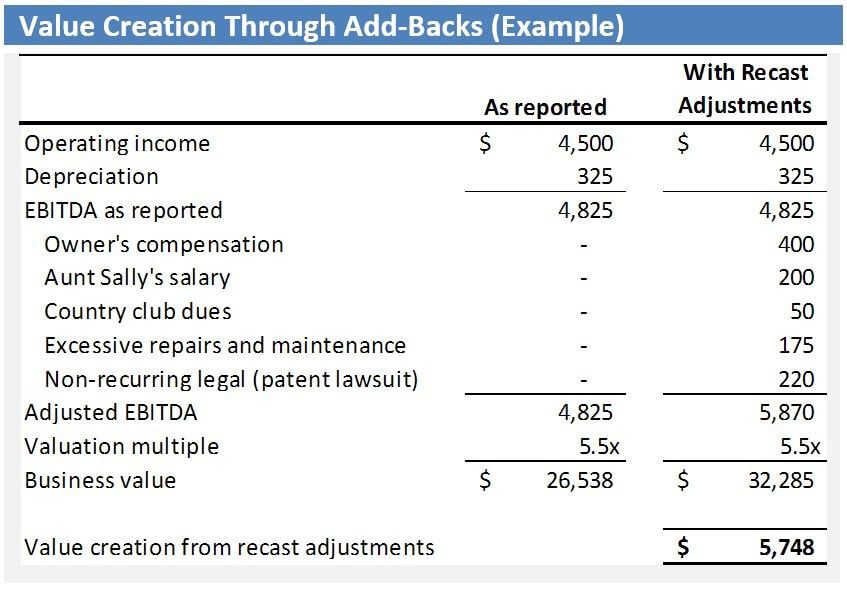
It is important to realize that recast adjustments are a two-way street. While investors will often provide value to a seller to the extent that they agree with the presented adjustments, they will also seek to reduce the reported EBITDA for expenses that are not reflected in the reported earnings of the Company. Buyers look for non-recurring revenue or credits to expenses (such as rebates) in an attempt to determine if the presented EBITDA figures are truly representative of the Company’s earnings. Other factors that buyers consider are whether or not there is ample expense in EBITDA to cover the operational needs to achieve the forecast projections. For example, a buyer may seek to recast the reported income statement to reflect a full year salary for expected hires that will be necessary in the coming year.

Conclusion

A business owner interested in selling the business should consider how value can be increased through the identification and presentation of recast adjustments. A detailed discussion with an investment banker about the fact pattern is the best way to determine opportunities to recast reported financial statements in a way that makes the Company more financially-compelling to the buyer universe. Doing so can literally translate into multiples of value for a seller.

© Copyrighted by EdgePoint. Paul Chameli can be reached at 216-342-5854 or via email at pchameli@edgepoint.com.


Preparing Your Business for Exit

By Paul Chameli,
Managing Director

Investment bankers often say that the optimal time to facilitate a capital transaction is when the Company is ready, the owners are ready, and the market is ready. While capitalizing on the confluence of those three factors can be affected by timing outside of their control, business owners can certainly prepare for ideal market timing. This article highlights general personal and operational considerations that will help ensure capital transaction success.

Company is Ready
While fundamental aspects of a business cannot necessarily be changed quickly, a number of business features and attributes can be implemented that often translate into more certain transaction success—and even potentially higher business value. These attributes generally relate to operational professionalism and creating institutional value for the organization.

A business owner can take a number of specific intermediate-term actions to prepare for a transaction. One of the most important is ensuring that a management team is present, prepared, and capable of leading the business in a post-transaction capacity. Ensuring that the business’ accounting and administrative records are orderly and up-to-date, sufficient to endure the scrutiny of sophisticated capital investors , is another easy task that contributes to transaction success. Business owners preparing their business for sale should focus on establishing and documenting policies and practices, which demonstrate “institutional value” and not reliance on one individual in the organization. This includes transferring/transitioning customer, supplier, and employee relationships to senior managers staying with the business post-transaction. While it’s an uncomfortable concept for many business owners, having a management team aware of and literate in the business’ financial profile also contributes to transaction success.

Business Owners are Ready
A business sale is likely the most emotional and significant event of a business owner’s professional life. Considerations for a business owner typically include those of a financial and personal nature. Business owners contemplating a transaction should understand their financial needs, taking into account their age, desired quality of life, and wishes for legacy to beneficiaries. This analysis usually requires the assistance of a good financial planner, tax accountant, and estate-planning attorney.

On the personal side, business owners should evaluate their desired post-transaction activities; this can range from continued management as an employee or partial owner to completely walking away from the business. Because various operational considerations are affected by the business owner’s desired post-transaction involvement, reconciling those feelings early permits the business owner and his/her advisors to ensure the Company is ready (see above). This also increases alignment between business positioning and the needs and desires of the target-buyer universe, which ultimately results in the highest possible value for the Company. Importantly, contemporary acquisition structures, particularly those employed by private-equity firms, permit much seller flexibility. As a result, business owners are essentially able to customize their desired post-transaction involvement with their company.

Market is Ready
Market readiness is largely measured by (and a function of) demand for investment opportunities. Record levels of cash from strategic corporations and private-equity investors available for deployment, low interest rates and easy credit policies, economic and political stability, and significant pressure to put capital to work creates demand for investment. When combined with a shortage of quality companies for sale, the result is a seller’s market in which business valuations increase. The current merger and acquisition market features all of these attributes and is an ideal environment for prepared business owners to transact their prepared businesses.

For both business readiness and business-owner readiness, quality professional advisors are a necessity. Business owners should retain a good transactional attorney, CPA, and an investment banker in advance of a capital transaction to evaluate the company’s preparedness, its ownership, and the market for a capital transaction. These professionals will evaluate the company and potential transaction from the buyer’s perspective, identifying business positioning, administrative, and personal matters that may impact transaction success or are inconsistent with the seller’s objectives. Working with these professionals well in advance of a transaction permits ample time to ensure the business and sellers are ready for market.

© Copyrighted by EdgePoint. Paul Chameli can be reached at 216-342-5854 or via email at pchameli@edgepoint.com.

Owners Must Answer the 4 W’s (Who, What, Why,…

By John Herubin,
Managing Director

It is well-publicized that the merger and acquisition market has recovered to near pre-recession levels and that it is a proverbial “sellers’ market.” Many external factors influence this increased buying activity—including low interest rates, increased availability of bank lending, historically low capital-gains tax rates, and abundant capital held by a large number of strategic and financial buyers. A business owner must answer four critical questions regarding their personal goals and objectives (internal factors), before embarking on a path to capitalize on these favorable market dynamics.

The 1st “W” – Why am I selling?

This answer varies with each owner we advise, but several common themes often appear when an owner begins strongly considering their business exit. The reasons include the following:

  • Owner has reached an age at which they have limited energy to continue running the business and believe it is time to retire.
  • Cash from a sale is needed to fund a comfortable retirement.
  • Owner desires a different or better quality of life than what they perceive they experience in their current role.
  • Fear that the industry is consolidating and that delay could miss the consolidation trend and window of opportunity to sell.
  • Owner realizes they missed the last “sellers’ market” and do not want to remain active in the business during the next down cycle.
  • Desire to preserve the legacy and goodwill the business and family name have established with employees and the community.
  • Owner or family illness or crisis.

This particular question often generates intense emotions and anxiety for the owner. We see the owners best prepared to answer this question are those who have communicated these emotions with the people around them that can provide honest and objective feedback. The sooner an owner begins acknowledging and confronting these emotions, the greater the prospect they will make an informed decision to sell, and be more comfortable with the outcome. This awareness process is often enhanced by speaking with close family members, trusted advisors inside and outside the business, and business peers.

The 2nd “W” – What am I selling?
When contemplating a sale, owners need to decide if the sale will entail all or a portion of their business. A portion may include the following:

  • certain divisions
  • the core business
  • real estate
  • intellectual property
  • a specific geographic location

A corollary to this question is determining what form the sale’s consummation will take. Generally, working with trusted professional advisors helps an owner decide—depending on what is being sold and how it is owned—whether a sale of stock, assets, license agreement, joint venture, or lease is preferable. These professionals often include an experienced deal attorney, investment banker, accountant, financial advisor, and insurance representative. Myriad tax, legal, personal financial, and estate planning implications arise, based on what is sold.

The 3rd “W” – Who do I sell to?

Today’s frothy market conditions provide a plethora of options for an owner to consider. Historically, the most obvious buyer choice was a direct competitor. Today, options also include many private equity or financial buyers flush with cash. A newer and growing participant competing to buy companies is the family office. These groups represent a family or group of families that may have previously sold a business, and seek to increase yield on sale proceeds by buying another company. Also, many international companies seek growth in the U.S. through acquisition, and are active competitive buyers.

Based on the answers to the 1st “W” above, a qualified buyer may also include the owner’s key managers or employees, or possibly the broader universe of employees through an Employee Stock Ownership Plan (ESOP).

Each buyer group’s investment and management style, goals, and results can influence which buyer is best pursued to meet the owners’ transition goals and objectives. Again, the owners trusted advisory team can provide input from experience to assist in determining buyers to target in a sale process.

The 4th “W” – When do I sell?

For owners inclined to sell (owner readiness), this is the easiest question to resolve. As discussed above, today’s market timing is as favorable as it was pre-recession. Many owners do not want to live through another downturn and are seizing the moment to market their companies for sale. Another factor indicating that now is a great time to consider a sale is the number and frequency of unsolicited and preemptive offers owners receive. This validates our sense that buyers are abundant and sellers are few.. When this imbalance will end is currently unclear. As we have seen in past cycles, it is not always easy to predict what external events impact markets.

Careful consideration joined with trusted advisor consultation will help answer the 4 “W”s above, enhance the chances of a successful sale transaction, and achieve the best “W” of all—one in the win column!

© Copyrighted by EdgePoint. John Herubin can be reached at 216-342-5865 or via email at jherubin@edgepoint.com.

One Buyer is No Buyer

By Russ Warren,
Managing Director

An unsolicited offer for millions of dollars has you and your spouse thinking about the life after business ownership. The offer is compelling, the buyer is credible and the buyer appears to be a good fit with your existing management team. So why are your key advisors telling you to wait? They keep telling you that “One Buyer is No Buyer”.

As good advisors they know that a competitive bidding process is the only way to ensure that you receive the best price and terms in the sale of your business. The old adage that “One Buyer is No Buyer” continues to be proven true by quality M&A advisors. In a recent transaction, this fact was proven true again. The names have been modified to protect the confidentiality of our clients.

Bill, the owner of a successful industrial components manufacturing company was contemplating the sale of his business early in 2008. His president, Bob, who owned no stock, wanted to buy the business and was trying to raise financing to do so. After hearing Bob’s offer (limited to what a bank would loan and what equity he could raise from family and friends), Bill decided to work with a firm of M&A advisors. EdgePoint was hired, and followed the structured process that has created value for countless sellers.

  • Fair market value was determined using company-specific information and current market data, and agreed with the seller as an acceptable price.
  • A thorough buyers list was prepared, consisting of financial buyers, and an array of U. S. and international strategic buyers.
  • “The Story” (a blind profile,Confidential Offering Memorandumand Management Presentation material) was written to consistently emphasize the value drivers for this particular business.
  • Buyer interest was obtained and orchestrated by seasoned professionals using deadlines and sequential competitive hurdles to obtain the best offer (price and terms)
  • Exclusivity was awarded only after all substantial terms were agreed upon
  • The process was “quarterbacked” and kept on track through Closing

Six months into the engagement a cash-heavy transaction closed at nearly double Bob’s original offer. (And, Bob gained significant ownership and continues to lead the business, which is adequately financed.) The successful buyer had a strategic reason to own the business, but was unknown to the seller prior to the sale process.

The ability to have multiple buyers compete for the ownership of your business is any business owner’s best interest. In fact, if you have received an unsolicited offer for your business this is a good indication that you have a business that may have significant market demand and value.

Often at the start of a sale engagement, the client will say, “I know who will buy my business – here is a list of the six best buyers.” Yet, for a variety of reasons (sometimes due to distractions of the moment), even buyers who have repeatedly told the owner they will buy his or her business may not make the top tier of offers. That is why it is vital to go to the market in a thorough, yet controlled process.

Confidentiality during the sale process is at the top of every seller’s concerns. It is not good to have employees, customers and other stakeholders hear on the street that “The XYZ Company is for sale.” The competitive auction process manages confidentiality, and only those who have the means to acquire the subject business are contacted, eliminating exposure to idly curious ‘tire kickers, a likely source of leaks’.

To get the maximum value, best terms and the highest certainty of close, the best potential buyers, wherever located, must be brought into a well-orchestrated competitive situation. That is the value brought by the right firm of M&A professionals. That is the value brought by EdgePoint.

© Copyrighted by EdgePoint. Russ Warren can be reached at 216-342-5859 or via email at rwarren@edgepoint.com.

M&A What Lever Do I pull

By Tom Zucker,
President

Imagine you have spent years preparing yourself and your business to be ready to transition to your employees or to an outside buyer, and you are now faced with the daunting task of deciding how to orchestrate the sell process. As you enter this new arena, you quickly realize that your inventory logistics, cash flow management and general business acumen have little value in this new game. The game is filled with unfamiliar terms such as earn outs, equity hold backs, normalized EBITDA and many others. You painfully realize that the stakes of this new game are significant to you and your family, and that the sell of your business is probably the biggest economic event of your life.

This familiar scene occurs to almost every business owner after deciding to sell. The primary desire of most business owners is to gain clarity of options, and subsequently have executed a successful transition that provides them the time and monetary freedom that they desire. Clearly an advisor or an advisory team is essential at this stage of your business to achieve the desired outcome. It is critical that business owners surround themselves with advisors that will clarify rather than complicate these options. The selling process in its entirety is very complex, but if broken down into smaller steps, the steps are actually logical and understandable.

A good example of this simplification is the decisions or “levers” needed to determine how you will get paid the purchase price. Purchase price can come in a variety of forms including cash, other company stock, notes, earn outs and many others. Almost everyone will agree that cash at closing is the most desired outcome. Unfortunately due to future company cash flows, bank financing or buyer’s equity limitations the ability to pay for the purchase price in cash is not always possible. Many investment bankers advise owners to be open minded to a variety of structures and options to determine if a higher purchase price adequately offsets the level of risk within the proposed structure. Often these “levers” move in opposite directions.

The following is a brief summary of the most common “levers” involved in the structuring of deals and transaction:

Earn-Outs

An earn out is designed to satisfy the seller’s desire to receive full value for future anticipated economic performance tomorrow. A buyer will often propose this structure when a customer concentration exists or future growth in a new or current customer is believed to be likely by the seller. A recent buyer summarized his perspective of an earn out as “I would be happy to pay the seller his desired price as long as the revenue and cash flows occur”. The biggest risk to a seller is that the new buyer may not properly run and maintain the business. The more uncertain an owner is about the new buyers ability to perform, the higher on the income statement the earn out will be based (i.e. revenue or gross margin). Earn outs are typically based on revenue or margin numbers, but any variety of metrics, financial or non-financial, can be set as “hurdles” for the payment of an earn out. Earn out payments typically range from two to five years based on the value that needs to be earned in an earn out structure.

Seller Notes

A seller note is another common deal structure that enables a higher price to be paid by the buyer. Most buyers try to minimize the equity invested in a business purchase to achieve higher rates of return on investment, save capital for additional purchases, or because of capital resource constraints. In 2002, many deals were completed that required seller notes due to the tight bank lending environment. While the assets and the cash flows of the business warranted higher purchase prices, the lack of debt financing and equity return expectations caused a value gap between sellers and buyers. Collateral is often available to secure the seller note, but typically in a subordinated position to the new senior bank.

It is not uncommon to have a combination of seller notes and earn outs in a deal to enhance the cash purchase price.

Equity Hold-back

An equity hold-back is the retention of equity ownership in the business along with the new buyer. The biggest risk that a new buyer has is the ability to transfer customers, retain employees and to enable a business to function in the absence of the previous owner. Many deals utilize equity hold backs to protect against the loss of the previous owner. Often an equity hold back will be accompanied with an employment contract for the previous owner. The seller would retain equity in the business. This structure is particularly attractive for a private equity firm that desires to make an investment and exit the investment within a five year window. Typically equity hold-backs are in the 10-20% range.

As an owner begins to pull the “levers” involved with the decision to sell, preparation and awareness are essential. The awareness of the levers available to an owner can propel you to a life of freedom, or back to rebuilding the business.

© Copyrighted by EdgePoint. Tom Zucker can be reached at 216-342-5858 or via email at tzucker@edgepoint.com.

M&A Timing- Industry Impact

By Tom Zucker,
President

We can all recall a business owner who delayed putting his company for sale, and subsequently the “market” deteriorated. That owner experiences disappointment and frustration knowing that he or she would have to wait for the next cycle for all conditions to be optimal again. This time they are ready to because of age, health or changing market pressures. The unfortunate part of missing this current cycle is that another “best time” may not come around for another 5 to 10 years.

So what makes a “market” cycle optimal and how does this impact an owners timing? The market for Mergers and Acquisitions often refers to interest rates, capital gains rates, business buyer optimism, buyer demand for companies within a particular sector and the overall growth prospects of your business. Many articles have been written about the impact of capital gain rates and interest rates have had on the M&A deal volume over the last several years. The impact that industry cycles have on M&A deal pricing and M&A buying interest is often the untold story.

The timing of the sale of a business is certainly impacted by the overall industry outlook and buying demand. Several recent examples of strong market interest driving excessive demand and high purchase prices:

Natural Gas/ “Fracking” Boom – Over the last several years, strong demand has prompted high purchase multiples for water hauling, gas well services, well parts machining or virtually anything related to this market.

Internet / Telecom Boom – In the late 1990’s, we experienced the height of escalated purchase multiples based on the prospects of the internet displacing all existing market players and creating a “new model” for doing business.

Real Estate/ Mortgage Boom – The mid 1990’s produced a tremendous amount of growth in the real estate and mortgage markets. Fortunes were made during this time of ample bank lending and loose credit standards. Real estate in prime areas of Arizona and Florida were appreciating at rates that many had never seen.

As with all good things, cycles end and normalcy returns to the buying market. We have met with many owners on the positive side of these discussions, as well as others who often lament not capitalizing on the selling opportunity. Those that regret not selling will often indicate that they did not see the signs of the changing market. In hindsight, we sigh that the signs were so obvious and clear.

As we begin to look for the next trends impacting our respective markets, we are constantly searching for the next big change. One industry that screams of potential market volatility is the automotive manufacturing supplier marketplace. Just a short while ago, banks were not interested in lending virtually anything to this market and the number of buyers interested in this market was limited. Today, many consider the automotive market to be “hot” and an area that both banks and buyers desire. The “Big 3” is certainly in better shape today than those bleak days of 2008. The number of car builds has grown exponentially from those dark days. Auto manufacturing suppliers are far fewer in numbers than prior to the government bailout of GM and Chrysler. Automotive suppliers have grown and prospered over the last 5 years as a result of low interest rates, positive impact from the low number of car builds in 2008 through 2010, and reasonably respectful relationships within the automotive supplier “food chain”. If you allow yourself to take a broader picture of this market and think through several scenarios of what the market might look like in 2016, the picture can get blurry and concerns can arise again.

These trends reveal that the automotive supplier market may be at a pinnacle. The low interest rates are expected by most to be rising in the near future. Many meetings with suppliers indicate that certain of the Big 3 are trying to squeeze suppliers again. International pressures are arising from new or strengthened competition within the automotive supplier base. Of course, today it feels good. The company is making money, the future is bright and all is good.

Think about your industry. How does it feel today? Draw on your experience and knowledge to project some likely scenarios for your business. Is it the right time to sell?

© Copyrighted by EdgePoint. Tom Zucker can be reached at 216-342-5858 or via email at tzucker@edgepoint.com.

Know when to Hold ’em Know When to Fold’em

By Russ Warren, Managing Director and
Tom Zucker, President

Success at the poker table depends on understanding the relative strength of the cards you hold and acting smartly – knowing when to walk away a winner. As Kenny Rogers’ song says, know when to hold ’em, know when to fold ’em.

Deciding when to sell a business depends on the same reasoning: facing what noted business author Jim Collins calls, ‘the brutal facts of where you’re at.’

A severe business downturn like we have just experienced re-orders the competitive playing field. The weakest middle-market players are killed off, others are marginalized, and some emerge as stronger, more robust competitors. Business pundits agree that many market sectors have fundamentally changed, and the current climate is not simply part of a regular business cycle. Consultant Tom Monohan, CEO of The Corporate Executive Board points out that customer needs change after a recession, and many companies never return to their former profitability.

The KEY QUESTION to ask when considering the sale of a business today is, “Is my business going to be worth more – or less – tomorrow?” It is also helpful to ponder, “What investment of time, talent and money would it take to make it worth more?” Am I willing to make that investment? Or, should I sell soon? Know when to hold ’em, know when to fold ’em.

If you were thinking about selling your business before this downturn, how comfortable are you to hang on until things return to ‘normal’? Ask yourself, “As the global economy resets to an uncertain ‘new normal’, what lurks in the shadows for my business?”

  • Changing customer requirements?
    • Consumers re-orient from ‘spend on luxury’ to ‘buy value and add to savings’
    • OEMs – autos, durables, health, IT, logistics – re-vamp platform offerings
    • Supply chain value propositions change – further winnowing and off-shoring
    • Mega mergers (set to re-ignite) disrupt long-time supplier relationships
    • Service expectations increase, willingness to pay decreases
  • Less favorable employee expectations, mobility and productivity?
    • The most productive employees are most demanding and mobile in a recovery
    • Government climate favors union activism – throughout manufacturing, services
  • More non-recoverable costs?
    • Unfunded mandates from key customers (free engineering, design, inventory)
    • Cap and Trade energy requirements
    • Stretched out payment terms
    • Limited ability to raise prices
  • Availability of needed credit and capital?
  • Additional Government Regulation?
  • Reduced sale proceeds due to higher long-term capital gains tax rates after 2010*
    • Today’s 15% will definitely be raised – to 20%, 25%, 30%, 35%?
    • Probably for transactions closed after December 31, 2010
    • Each 10% bump in the rate requires 13% to 15% more EBITDA to stay even

Add these uncertainties to the reasons a sale was of interest before the tsunami hit, and the best time to explore a full or partial sale of your business may be sooner than later.

The typical sale of a middle market business – to an unrelated party, ESOP or management – requires six to twelve months (often depending on factors beyond the seller team’s control) from the time a financial advisor like EdgePoint is engaged.

To a buyer, a business is clearly more valuable when profits are rebounding (like now for many businesses), than if the loss of a major customer or other material adverse change were looming.

So, you might consider taking some chips off the table now to hedge against future uncertainties. It is feasible to sell part or all of a business at a fair price in today’s market. There is demand for mid-size businesses that have come through the recession and are recovering ground, especially if they performed better than their industry in the downturn. And, because many owners are not yet ready to sell, there is not yet enough supply to fill that demand. Buyers are making allowances for recent profit performance if current monthly improvement can be documented.

We will be glad to discuss your situation in complete privacy, and help you assess when is the best time to begin the process, given your company’s recent performance and outlook. Call Russ Warren: (216) 408-7901 or Tom Zucker: (440) 724-5406.

See the article “Window of Opportunity – Paying Uncle Sam Less When You Sell Your Business” by Warren and Zucker.

© Copyrighted by EdgePoint. Russ Warren can be reached at 216-342-5859 or via email at rwarren@edgepoint.com. Tom Zucker can be reached at 216-342-5858 or via email at tzucker@edgepoint.com.

How Important is Your Management Team when Selling to…

By John Herubin,
Managing Director

The M&A market has once again reached activity levels nearing the pre-recession peaks. There are numerous reasons for this level of activity, but one of the more visible influences is the growth and availability of funds to purchase companies from financial buyers, more specifically private equity groups (PEGs). You have likely heard the saying “business is people”, and this axiom is being demonstrated by many PEG buyers in today’s market, where management teams have become a particular focus. We have increasingly seen PEGs place an emphasis on existing/in-place management teams as essential for determining, maintaining and increasing an entity’s value (their investment). Strategic buyers are generally less concerned with management strength as they will likely consolidate/eliminate redundant positions and functions to realize efficiency and operational synergies, although even some strategics will need key managers for an acquisition. Many of these PEG buyers do not have the “bench strength” to place key management people at the acquired company, and it may take time and significant expense to find qualified management, or augment and supplement existing key management employees. Depending on the particular business, key management employees may include sales managers or key sales people, CIO, CFO, COO, CTO, product or design engineers, or anyone viewed as being integral or essential to the continuing growth of the sales, operations, or customer/vendor relationships of a business. This current emphasis on “people” should not be ignored or minimized by a selling owner.

We have seen attractive offers erode in value after operational due diligence reveals that the management team is not very strong in a capacity desired by the PEG buyer to maintain or increase the profitability of the business. Many times the buyer is not directly exposed to the key management employees until the latter stages of due diligence, so making sure the employees are capable of articulating or demonstrating their competency and value is crucial to the seller.

Selling owners should continually assess the strength and weaknesses of their management team. The sooner before a sale (1-5 years) an owner begins looking at management team strength, the more options available to ensure the management team will ultimately be desirable and valuable post-sale. We have seen companies enhance their management teams through any or all of the following:

  • Hire from competitors
  • Executive search firms
  • Through acquisition
  • Recommendations from advisory boards
  • Consultation with potential buyer pre-sale

Most deals we see in the lower middle market require the selling owner to remain with the company post-sale to assist with transition, generally for a 6-12 month period, and longer if private equity purchased. If the owner is not going to be active beyond this period, they should consult with their investment banking advisor to determine what types of buyers may ultimately be approached. Some PEG buyers may expect the succeeding management team to be ready to “plug and play” and seamlessly operate the business. This expectation may assume that key management can perform beyond their current capabilities (i.e. increase sales (2-3X) in a short period of time, grow in foreign markets, expand product lines, industries served, or current operating locations, pursue and complete acquisitions). Management may not be capable or experienced in any of the above.

If the owner has some level of contingent compensation or value tied to the deal (which is often the case), they need to understand these expectations, and more importantly the management team’s limitations prior to moving forward with a particular buyer to make sure the management team is capable of meeting those future growth and profitability hurdles. Sometimes this assessment by the owner is based more on qualitative and not quantitative considerations. We recently conducted an engagement to sell a client’s business that received numerous offers to purchase. As we assessed the offers, one stood out with a quality PEG firm that was higher in dollar value over the others, although there was a meaningful contingent value component to the selling owner. Upon further discussion with the prospective PEG buyer, it became apparent that their expectations of the successor management team were to aggressively grow the business into multiple new markets at a rate that they had never previously attempted or achieved. They were not comfortable or capable of performing at the projected levels. This can be a recipe for disaster for an owner, the PEG buyer, and the viability of the business.

Our client valued his management team which was talented and capable, but was not quite the skill level fit for the level of expectations that the PEG buyer desired. The owner did not want to jeopardize his future contingent value, the livelihood of his employees, or the future success and existence of the business in a small community. We ultimately negotiated a deal with a family office buyer that had a slower and more deliberate growth plan that meshed better with the talents and capabilities of the existing management team. Having a longer growth strategy enabled the management team owners and buyer to assess key employee needs going forward to meet the growth and profitability strategy they desired.

Since many PEG buyers expect a willing and capable management team post-sale, and often offer post-transaction equity-based incentive compensation structures, the current owner needs to assess whether the management team possesses the requisite ownership mindset. The PEG buyer will want to insure that the management team is properly incented to continue growing the business and executing on the buyer’s strategic plan which will increase the value of the PEG’s investment as well as the personal net worth of the management shareholders. Several types of stock ownership or incentive compensation plans may be available pre-sale to incentivize and retain key employees and management. This strategy will enable management to experience the feeling of actual ownership and adopt a more proprietary role in operating the business. Some management team members are not interested, nor capable of taking on an ownership role. The current owner needs to discern this so that appropriate measures can be taken to minimize or eliminate the impact on sale value this may have.

These same employees may also possess key customer relationships, industry expertise, or technical skills that need to be preserved post-transaction. This is often accomplished through such measures as non-compete and non-solicitation agreements, and retention bonuses to ensure certain key employees stay through the completion of the transaction and for a period following.

In the event an owner identifies a management team need pre-sale, they should cautiously consider and assess the impact of hiring to meet that need may have on the ultimate sale price. We advised a client several years prior to selling that a subsequent buyer would likely decide he needed both a more experienced CFO, and an outside sales representative. Since every dollar used to hire management team talent reduces EBITDA (profitability), spending $250,000 on these positions could possibly result in a reduction of sales price of $1,500,000 (in this case the company ultimately sold for 6X EBITDA, so 6 x $250,000 = $1,500,000). The client realized that by hiring an outside sales rep with established relationships; he was more likely to generate greater profitability sooner than by hiring a CFO over the currently competent Controller. The PEG buyer was able to find a more desirable CFO to meet their long term strategy. The seller did not spend the money to hire the CFO which resulted in a greater profitability and ultimately a greater sales price for the seller.

The following questions about the management team are some of the more important things for both sellers and buyers to know in determining management’s value to the business:

  • How active is the owner on a day-to-day basis?
  • Who do key customers call when there is a problem?
  • Do key managers receive performance reviews and are they performing to expectations?
  • Do key management employees think and act like owners?
  • If the owner is hit by the proverbial “bus”, how will the company operate?
  • Does the management team meet as a group to discuss short and long-term strategic goals with the owner?

It is the rare instance where a PE buyer is not critically assessing the value a management team contributes to a selling business. Owners who are going to eventually sell should be vigilant about continually assessing the strengths and weaknesses of their management team also. This internal diligence should include consulting with their trusted advisors to grow and maintain these essential assets (management team) that will attract a premium value from a buyer as time moves closer to a sale date.

© Copyrighted by EdgePoint. John Herubin can be reached at 216-342-5865 or via email at jherubin@edgepoint.com.

Got Deal Flow?

By Tom Zucker,
President

The success of any buyer of private businesses depends on seeing ample, attractive “Deal Flow”. Attaining this state has humbled many a skilled executive. I recall meeting with a very well networked ex-CEO of a large multi-national company who had formed his own private equity firm to acquire privately held companies. In our initial meeting he was filled with bravado and certainty of the ease he would have in securing ample deal flow to satisfy his acquisition interests. About six months later, he approached me at a cocktail party remarking on how difficult it was to see deal flow let alone deals that met his stringent criteria. I responded calmly that securing deal flow is an art, requiring a consistent and patient approach and ample time to perfect.

To add direction and value to your efforts to secure ownership of a privately held business, I would like to share with you some of the lessons that we have learned in our constant search for “deal flow”:

  1. Buyer Image: The impression that a business buyer portrays to the deal community, a business owner, and the owner’s advisors is critical to success. It is important to have your acquisition entity incorporated, a succinct written introduction with buyer criteria summary prepared and business cards with your acquisition entity ready to be shared. These simple preparatory steps will tell a business owner or business advisor that you are prepared, motivated and serious about acquiring a business.
  2. Good Guy: Most closely held business owners are perceptive and private. They have survived many years as a successful business owner by perfecting the art of reading people. The business owner will often ask his or her advisors if the buyer is a “good guy” (or gal). This is a code to determine whether the buyer is approachable, non-egotistical and someone that resembles the typical exiting owner.
  3. Action, Not Words: Getting deal flow is a full-time effort that requires tenacity, intelligence and persistence. Follow-up calls indicate serious intent. The idea of getting deal flow from a few lunches with deal attorneys, transactional accountants or investment bankers, however, is unrealistic. While these meetings are essential to credentialing yourself, alone they will not produce success. We have found that direct contact with owners is by far the most effective way to find deal flow. Yet most owners have built barriers to ensure privacy about their business and have a private life.
  4. Make it Warm: One may identify that a business owner is of a certain age or hear a rumor that a certain company might be for sale. An eager inexperienced buyer might feel compelled to make a cold call and “take action”. Our experience has shown that finding a warm introduction significantly increases the likelihood of getting an introduction. A warm introduction point is critical to a buyer’s success. If you are not well networked or do not know any direct points of introduction, I would encourage you to engage a well networked investment banker to serve as your gateway to “deal flow”.
  5. Be Responsive: The nature and timing of the responses to investment bankers, accountants and other advisors to business owners is critical. You are in competition with other buyers. Of course, a buyer will be responsive to a business owner but respecting the trusted advisor and being responsive is very important. In addition, the quality of a thoughtful response to the business owner or advisor will create a positive impression. This impression is critical to future deal flow from this advisor and also from other advisors. It is amazing how quickly impressions are formed about the buyer’s eagerness and capabilities based on simple matters such as timeliness of a response or follow up.
  6. Fish Where the Fish Are: Your acquisition criteria should be specific enough to focus your search where you can offer an attractive value proposition to the owner (e.g. shared values, relevant experience, etc.) and where your financial resources are competitive. Search aids might include: industry directories, conferences and shows, ThomasNet, LinkedIn to name a few.

Buying the right business is all about deal flow. The quantity of deals that a motivated and focused buyer can see greatly increases the chances of successfully acquiring a business. If you are trying to increase your deal flow, you are welcome to contact EdgePoint Capital to learn how we can assist a buyer in his or her acquisition initiative.

© Copyrighted by EdgePoint. Tom Zucker can be reached at 216-342-5858 or via email at tzucker@edgepoint.com.

ESOPS: Myths vs. Facts

By EdgePoint

If you are contemplating ownership transition, and your management team is capable of running the business, an employee stock ownership plan (ESOP) may be on your list of options to consider.

An employee stock ownership plan (ESOP) is an ERISA trust that invests primarily in the securities of the employer Company. A sale to an ESOP is a tax advantaged management buyout (MBO) method that provides significant tax advantages to the Company and often the seller. Tax advantages ranging from the deduction of principal on ESOP formation debt up to the complete elimination of income tax for 100% ESOP owned S-Corps create a tailwind for these transactions, helping ensure success after management takes over the business. There are plenty of other non-financial reasons to consider an ESOP, but the tax benefits can be compelling.

In many situations, these benefits of an ESOP make them an attractive transition option for business owners. However, myths surrounding the creation and maintenance of an ESOP may make some business owners wary of this option. Below, myths regarding Control, Ownership, Structure, Size and Cost, Transaction Value and Employee Age are dispelled.

Control

Myth: “I will have to give up control of my business.”

Fact: Control of the ESOP is maintained by a Trustee, who is often the selling shareholder or member(s) of the management group. Very few decisions are required to “pass through” to the ESOP participants.

Ownership

Myth: “My employees will own the Company and have access to my financials.”

Fact: ESOP shares are owned through retirement accounts, not by individuals. Required financial information is limited to share values in participants’ accounts, which is determined by a third party valuation firm annually.

Structure

Myth: “You need to sell 30% of the Company in order to have an ESOP.”

Fact: When structuring an ESOP, 30% is only theminimumpercentage in order to qualify for C-Corp tax deferral under 1042 rules. Otherwise, any amount of shares can be purchased in an ESOP.

Size & Cost

Myth: “Your company is too small for an ESOP. It costs too much.”

Fact: Any size company can form an ESOP. Administrative costs (TPA) are similar to those associated with 401(k)s, plus the annual valuation. Initial ESOP valuations are usually $10-25 thousand up front, and then less for annual updates. Other than the formation and funding for repurchase liability, there are no other significant costs to create or maintain an ESOP.

Transaction Value

Myth: “A sale to an ESOP will not result in highest price.”

Fact: While this may be true in some markets with some companies, each transaction is different, and the final agreed upon sale price depends on the market, specific situation of the company and valuation firm. Many times an ESOP buyer can pay the highest price for a company.

Employee Age

Myth: “My workforce is too old and near retirement.”

Fact: Early retirees actually help to distribute the ownership of an ESOP, and can be planned for. If a workforce is mostly older, the Company will have repurchase obligations coming to them earlier. This may cause a liquidity need. However, flexibility options exist that can be built into the ESOP plan, such as deferral of repurchase payments while the ESOP formation debt is being serviced, delays in the start of payments to participants and the stream of payments to participants. Additionally, if an older workforce starts to retire within a few years after formation, not all of the stock would have been allocated and the company has less time to grow its valuation. This results in less shares being redeemed, and for less value than if they had been there longer.

When reviewing your transition options, if you find your management team capable of running the business, regardless of whether you think they “have the money” to buy you out, contact us. Your business could be an ideal candidate for an ESOP, and we have been able to finance management teams for both management buyouts (MBOs) and ESOPs with little or no equity.

© Copyrighted by EdgePoint. Tom Zucker can be reached at 216-342-5858 or at tzucker@edgepoint.com