The “Catch 22” of High Synergies Fit in Merger…

By Paul Chameli,
Managing Director

By design, merger transactions can have significant strategic value to two parties with different yet complementary operating models and philosophies. While these operating and cultural differences can yield a stronger and more complete organization, they can also make for a difficult transaction process—which in turn may put at risk the great strategic potential contemplated by the combination in the first place. This article illustrates this common transactional phenomenon and proposes several techniques to ensure that tension inherent in opposing but complementary business philosophies does not prevent a stronger combined entity.

Consider the following fact pattern:

Company A, a small but growing engineering firm, achieves great success in the industrial sector as it provides the same sophisticated services offered by the largest engineering firms in the world, but with client responsiveness and agility common in smaller firms. This responsiveness and agility, combined with some entrepreneurial risk-taking, contributes to better profitability. At the same time, Company A needs a succession plan, deeper operational resources, and the resources of a large engineering firm to continue to support its growth. Company B is a $1 billion international firm with depth and sophistication of resources to support growth. Overly conservative because of adherence to strict operational processes, Company B is laden by bureaucracy and lack of responsiveness. While possessing deep marketing and other operational resources, the organization is too heavy and sluggish to penetrate the fast-growing industrial sector. Furthermore, layers of oversight and conservative decision-making contribute to limited risk taking—and lower profitability.

Like all successful merger transactions, Company A and B realize they can both benefit from becoming one. The merger gives Company A the scale and international access needed to continue its growth. For Company B, the merger introduces a culture of vibrancy and entrepreneurship that contributes to far greater profitability on its core business. However, in classic “Catch 22” fashion, the same factors that make the transaction such a synergistic fit and success make it more difficult to execute from a transaction perspective. The exact characteristics that each needs in the other turn out to be those that cause trouble during diligence and legal documentation. Company A is concerned that greater recordkeeping and other administrative burdens from integration into Company B will impair the flexibility that makes it successful and profitable; likewise, Company B is concerned that it will be unable to keep up with the more agile and entrepreneurial Company A and is uncomfortable with some of its historical risk profile. And both parties—relying upon their historical culture—are emboldened in their transactional positions, while acknowledging they need the other’s culture to survive and grow in the future.

So how can two very different parties that need each other so much ensure that the fantastic transaction benefits are not lost to cultural differences? While it’s easy to say that both parties need to understand the other’s perspective, seasoned transaction professionals know this is easier said than done, particularly in the heat of transaction negotiation. While there is no foolproof plan to ensure a transaction stays on track in this situation, a few tactics can be employed to prevent the Catch 22 from destroying a potentially perfect combination.

  • Establish Early Integration Expectations of Both Parties — While most early transactional negotiations do contemplate high-level integration analysis, most often this topic is deferred until much later in the process. In addition to discussions about value and strategic potential early in the transaction process, both parties should not be bashful about using early conversations as a forum to explore integration specifics. Planned reporting hierarchy, extent of decision-making, level of financial and other business-management reporting, and the risk-management processes and policies of the respective parties are good topics to consider before the parties decide to negotiate on an exclusive basis. For Sellers running an auction process, requesting the Buyer universe to document early their expectations for these integration items, while the Seller has leverage in the transaction, is ideal. If a Buyer is unable to document how they will take into account the unique aspects of the acquired business, it might mean that the buyer is unable to appreciate a different business model.
  • Remember Strategic Fit — During due diligence and document negotiation, the cultural differences of both parties become very evident. For example, a smaller company’s lack of formality in documentation may cause hairs to rise on a larger more corporate buyer; similarly, a large strategic organization’s diligence level and detail may come across as overly burdensome to a smaller Seller and may be perceived as a preview of the hassle associated with integration. To prevent this from causing the transaction to derail, a “check-in” during diligence, in which both parties meet to reconfirm strategic fit, may be needed to ease tensions around the cultural differences and reassure both parties.
  • On-Site Buyer Visits — A common tactic to alleviate Seller’s concern about oppressive post-transaction management is on-site visits to the buyer. Most of the diligence and negotiation process is at Seller’s site. This one-sided investigation can certainly contribute to a Seller’s integration anxiety. Scheduled on-site visits to the buyer, where Seller can actually view the processes in place, are very effective to promote good feelings about synergy. Buyer should demonstrate some of the benefits of integration into their organization, such as access to a very large Human Resources and Marketing Department, for example. Allowing buyer to see the benefits of integration, in the middle of sometimes tense negotiations, is an excellent way to solve problems associated with cultural disconnect.
  • Disconnect Diligence from Operations — It is common for a Seller to associate the due diligence process with post-transaction life. As a result of the diligence investigation, Sellers often envision long interrogation and oppressive recordkeeping as part of life with the Buyer. It is important for a buyer to disassociate diligence from integration, understanding that the Buyer has an unpleasant job to do before both parties can realize the great benefits of combination.

The cultural differences that often come with the greatest strategic fits can be exacerbated by transaction-process functions. When parties can work through cultural differences during this process, the potential for a promising partnership is assured.

© Copyrighted by EdgePoint. Paul Chameli can be reached at 216-342-5854 or via email at pchameli@edgepoint.com.


Deal Rumors: Deny Deflect, and Disclose

By Tom Zucker,
President

Rarely am I able to suggest that anyone follow the example of a politician, but these unique creatures show ways that people often handle sensitive communications during an M&A process. During every campaign cycle, we observe numerous candidates perfecting the time-tested techniques of denying and deflecting challenging questions. Although I despise politicians’ verbal maneuvering and lack of transparency, I respect how they achieve their main objective of preventing discussion of a topic that they want to avoid. With this background, below I consider several methods that people use to handle the most sacred truth…my company is for sale!

Deny
“I have no idea where they would have gotten that idea”, “Just rumors”, and “My company is not for sale”, are just a few of the common responses that an owner will use to deny the fact that indeed, their company is for sale. The outright denial is a common technique to refute the rumors. A denial might be appropriate where an owner is legally bound by a Confidentiality Agreement with a buyer (e.g., a publicly traded buyer) not to disclose that a transaction is in process. This approach often does not feel consistent with the character of the owner, but certainly would make a politician proud.

Deflect
Typically, early in a sale process, the business owner will deflect questions and observations. Recently, the V.P. of Marketing for a client of ours approached the business owner with the comment, “I recently heard from a supplier that our company is on the market”. Despite the efforts of a skilled investment banker using code names, Confidentiality Agreements, only contacting senior level executives, and demanding a very tight timeline, occasionally someone in this chain of communication will breach confidentiality regarding the deal. Our client was disappointed in the realization of a breach, but was forced to respond quickly. He confidently responded to the executive, “Everything in life is for sale at the right price.” In this example, the deflection seems to have satisfied the V.P., but there is no certainty that the owner’s answer completely dismissed the V.P.’s lingering concerns (or those of others involved).

Disclose
Many business owners utilize some of the previous approaches in the early stages of the sale process and then eventually disclose the sale prior to Closing. The later in the process that an owner can disclose the fact a sale is likely to occur, the less likely it is that employees, competitors, or other parties not directly involved in the negotiations will influence the outcome. Typically, an owner will notify a few key managers early in the process to provide proper insight and support, and then expand the number of internal people aware of the pending event as buyer interest and offers solidify. The disclosure to customers, other employees and family members is often deferred until just days or weeks prior to the closing of the sale. An owner must resist the desire to share the good news and defer disclosing until they are ready to handle the barrage of inquiries, questions and concerns and the deal has sufficiently solidified. As one would expect, it is often those with less facts and control that will worry the most and often extend their anxiety and uncertainty to others who would be impacted by the sale. It is human nature to fear uncertainty and circumstances beyond one’s control.

In order be prepared for questions about the sale before you have raised the issue, an owner should work with their investment banker to be prepared. Developing a communication plan at the start of an engagement is critical. The owner should have a truthful answer prepared for various inquiries, depending upon who raises the issue (i.e. employees, customers, suppliers). The answer may be slightly different for each or perhaps a consistent answer will be needed- each deal is different. It does not happen often, but being confidently prepared to answer the question of whether a company is for sale can be rehearsed and to properly address the inquiry.

In business, as in life, communication can be everything. During the sale process, this statement is even more evident and true. The intensity of emotions that a business owner has as he or she begins to think about selling “their baby” is very high. The key managers anxiously observe private conversations and unusual requests while thinking to themselves about the security of their job. The advisors (i.e., attorneys, accountants and bankers) strive to protect and advise long-time clients, but they are also motivated to preserve their future business with their client. It is in this environment that a skilled investment banker works, and why deal communications are so critical to a successful transaction. Preparation of a communication plan for this process may not qualify a client to run for political office, but will certainly give them comfort that they are answering with integrity in a manner that does not jeopardize the success of the sale.

© Copyrighted by EdgePoint. Tom Zucker can be reached at 216-342-5858 or via email at tzucker@edgepoint.com.

Window of Opportunity- Paying Uncle Sam Less When You…

By Russ Warren, Managing Director and
Tom Zucker, President

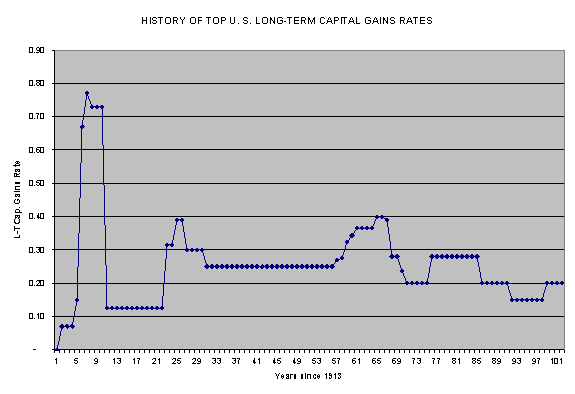
At 15%, today’s maximum long-term capital gains tax rate (LTCG) is the lowest it has been in the last 75 years (see chart below). In 2003, this rate was reduced to 15% from 20%, with a sunset provision, and is effective through 2010.

If Congress and the Administration were to do nothing, the LTCG rate would go back to 20% on January 1, 2011.

However, with bailouts, stimuli packages and new social programs collectively costing trillions to fund somehow, what better place in Washington’s view to raise revenue than from capital gains? There is also historical precedent. As recently as 1996, the LTCG rate was 28%. Throughout the 1970s, the rate was 28% to 40%.

The prospect of paying more to Uncle Sam if you close the sale of all or part of your business after December 31, 2010 is starting to get on owners’ radar screens. The impact on an owner’s wallet is shown by the following hypothetical example.

If a business owner obtains $10 million more in proceeds (that qualify as long-term capital gains) than his or her tax basis, the LTCG tax at 15% would be $1.5 million. However, if the LTCG rate were raised to 30%, the extra $1.5 million tax bite would reduce take-home proceeds from $8.5 million to $7 million, an 18% reduction.

In other words, to realize $8.5 million in ‘take home’ proceeds at a constant pricing multiple, the business would have to generate a significantly higher EBITDA. As shown below, for each 10 percentage point increase in the LTCG rate, a business would need to generate 13% to 15% more in Earnings Before Interest, Taxes, Depreciation and Amortization.

LTCG Rate Req’d EBITDA Assumed Multiple Req’d Proceeds Keep Factor Take Home
15% 2,000 5 10,100 85% 8,500
20% 2,125 5 10,625 80% 8,500
25% 2,267 5 11,333 75% 8,500
30% 2,429 5 12,143 70% 8,500
35% 2,615 5 13,077 65% 8,500

So Uncle Sam is having a limited-term offer – a 15% capital Gains Tax. But to take advantage of this offer, time is of the essence. The typical sale of a middle market business – to an unrelated party, an ESOP or management – requires six to twelve months (depending on factors often beyond the seller team’s control) from the time a financial advisor like EdgePoint is engaged. So, to close a transaction by December 31, 2010, planning and discussions should begin as soon as possible. In the world of Taxes, ‘almost getting it closed by the deadline’ doesn’t count, and could cost a lot of money.

We would be glad to discuss your situation in complete privacy, and assess the best time to begin, given your company’s recent performance and outlook.

© Copyrighted by EdgePoint. Russ Warren can be reached at 216-342-5859 or via email at rwarren@edgepoint.com. Tom Zucker can be reached at 216-342-5858 or via email at tzucker@edgepoint.com.

Why Deals Don’t Close

By Tom Zucker,
President

After working decades to develop your business and career, you finally arrive at the decision to sell the business. You’ve done a fantastic job identifying the buyer and negotiating the price and other sale terms. You’re relieved and satisfied, and can see the “closing” within a short 90 days, and the approaching transition to what comes next.

But, then something happens – the transaction falters, stalls, grows apart. You’re left wondering, “what happened?”

After closing hundreds of transactions, we understand that transactions can derail for many reasons. However, we’ve observed a consistent series of reasons that dominate the question “why do deals not close?”

Reason 1: Lack of Financing – The most common reason deals stall is a failure to arrange suitable financing. Financing is the life blood of every deal. Over two-thirds of a transaction’s purchase price is commonly financed in some way – bank financing, subordinated debt, seller financing, or junior equity.

Many seller’s expect that the buyer of their business is skilled and knowledge in the art of financing a business. Quite often this is a very dangerous assumption. In fact, many buyers of closely held companies do not have strong financing experience. The seller or their investment banker must take a proactive role in assisting the buyer in securing the necessary capital. The seller’s advisor should be able to confirm that the buyer is dealing with the right type of lenders and that the lenders have the required information to quickly get funding approval.

Reason 2: Emotions Run High – The second most common reason business sale transactions stall is out-of-check emotions. Selling a business is a highly emotional event; it involves many issues, and much uncertainty, stress, and family pressures. It bears on many aspects of the owners’ lives. From the joy of expecting a multi-million dollar payoff, to the thought of leaving trusted 30-year employees, emotions can be intense, and parties are on edge.

During the sale process, your ability to check emotions at the door and allow your advisors to guide you through the transaction can be critical to success. Know that while what the Buyer and his advisors say or do may at times infuriate you, it’s in your best interest to permit your skilled advisor to insulate you from emotional issues. Be smart, defer to your advisor’s experience rather than just “reacting.”

Reason 3: Ongoing Business Performance – The process of closing the sale of one’s business brings new distractions and requests for your already scarce time. The buyer’s request for documents, endless questions about your business, meetings with advisors, negotiations, and many multi-party dealings all but evaporate any time for running your business. In addition, it is hard for a departing owner to remain focused on the business when visions of their future with more personal capital and time flash in front of them. Unfortunately, it is at this time that your business is most in need of your leadership and focus.

In order to survive the closing process, it is critical that you have an experienced and disciplined team comprised of your investment banker, lawyer and accountant to deflect much of the distractions as possible. These advisors can enable you and your team to remain focused on keeping your business on track. If Sellers fail in this regard, buyers get nervous, have reason to renegotiate valuations, get concerned about customers leaving, and can become apprehensive about closing the transaction.

Reason 4: Creeping Greed – The allure of money is only intensified by the opportunity for more money. As the process of selling your business advances, owners and advisors will work to secure the best deal and terms possible. During this process many owners and their advisors become filled with more greed. While Gordon Gecko from the famed movie Wall Street will tell you that “Greed is good”, it is our experience that “too much greed kills deals!”

It is important for the owner to remain in control of the deal and to ensure a principled approach to the final negotiations. Often over-zealous advisors will attempt to prove their value to a deal and their client by over negotiating documents or non-essential deal points. When millions of dollars are on the table, this over negotiation often breeds distrust, discomfort, and annoyance among the parties. In addition to the distrust, the process of over negotiating often costs the deal by losing essential deal momentum. It’s very, very important to keep the greed, the emotions, and the posturing of negotiations in balance with the parties’ end objectives, which includes getting to closing with reasonable levels of certainty and risk.

Reason 5: Lack of Accessible and Reliable Answers – The last, but definitely not least, reason deals crash is seller’s failure to quickly respond with clear answers to buyer’s questions. If a buyer has to struggle to find answers to relevant questions, it becomes a challenge for the buyer to pay the offered purchase price. We call this “getting the house in order.” It’s absolutely critical that legal and accounting documents and other supporting materials are in place and at hand well in advance of the closing process. The agreed time frame between sale agreement and closing date should not be a period of forced “discovery,” but one of simple “confirmation.”

All information must be prepared and organized into a very clear and consistent data package and made available electronically or in hard copy so that the buyer’s due diligence team can quickly and easily access it for answers to routine and relevant questions.

While there are many reasons that a sale of business does not consummate, the lack of credible information, greed, unchecked emotions, lack of financing and a drop in your business performance are the most common reasons for a failed deal. It’s one thing to get an offer to buy your business; it’s another thing to close a transaction in the midst of emotions and greed, customer’s movements, and overall business risks. The job of a skilled intermediary is to navigate these issues and guide the seller to the transaction closing they’ve worked their entire life for.

© Copyrighted by EdgePoint. Tom Zucker can be reached at 216-342-5858 or via email at tzucker@edgepoint.com.

When to Consider an ESOP

By EdgePoint

Business owners should consider an Employee Stock Ownership Plan (ESOP) when their management team is capable of running the business without the selling shareholders (or can adeptly replace the owner/manager) and the company doesn’t face imminent distress.

After a company’s sale to an ESOP and the eventual retirement (exit) of majority shareholders, the management team usually operates the business. In many cases, members of management may also be the ESOP’s trustee. In either case, management is running the business as if they purchased the company. If current management is not capable of running the business without the departing shareholders, then suitable management replacements must be found or the Company and ESOP risk failure.

EdgePoint often describes ESOPs as a “tax-advantaged management buyout.” Because management runs the business, and are often the highest paid, they have a larger share of ESOP share allocations. As owners, management benefits from their own success—this can be an effective motivator for the team. Tax advantages ranging from deduction of principal on ESOP formation debt to the complete elimination of income tax for 100 percent ESOP owned S-Corps create a tailwind for these transactions, helping ensure success as management assumes control of the business. There are plenty of other nonfinancial reasons to consider an ESOP, but the tax benefits can be compelling.

Other parameters to consider include the size and health of the company, the age of its workforce, and its debt capacity. Almost any size company can afford an ESOP, contrary to the common “minimum-size” myth. Costs to administer an ESOP are very similar to those of a 401(k), and most companies can afford the third-party administrator (TPA) that manages the 401(k)’s retirement trust accounts. The primary difference with an ESOP is that every year the company must secure a certified valuation of the shares to determine their value to participants and establish the buyout price for new share offerings or terminations/retirement redemptions. Valuations can cost from $5,000 to $25,000 for most companies per year, which is usually not prohibitive. Outside trustees, bank financing, attorneys and consultants are additional and often optional costs, but the primary annual ESOP administration costs are the TPA and annual valuation.

Workforce age matters merely because of repurchase-liability planning, but is not necessarily prohibitive. If a workforce is mostly older, the Company faces repurchase obligations earlier. This may trigger a liquidity need. However, flexible options exist that can be built into the ESOP plan, such as deferring repurchase payments while the ESOP formation debt is serviced, delaying the start of payments to participants and regulating the stream of those payments. Additionally, if an older workforce starts to retire within a few years after ESOP formation, not all of the stock will be allocated by then, and the company has had less time to grow its valuation. This slows share redemption, and redemptions are for less value than if the shares had been there longer.

Debt capacity is important to a new ESOP for two primary reasons. First, because no “equity” is infused by shareholders to purchase the shares, debt is the only funding source. Second, debt is used for liquidity to operate the business and eventually repurchase shares from ESOP participants. If the Company has limited borrowing ability, it makes ESOP a less viable alternative. Alternatively, the benefits to financing an ESOP is that higher tax advantages allow lenders to lend more money into an ESOP due to the business’ higher cash flow, and personal guarantees are generally not necessary. Certain government loan programs and mezzanine lenders have special lending rules that promote financing ESOP transactions.

If you are contemplating transition, and your management team is capable of running the business, regardless of whether you think they “have the money” to buy you out, contact us. We have financed management teams for both management buyouts (MBOs) and ESOPs with little or no equity.

© Copyrighted by EdgePoint

What to Do When Less is More: Planning and…

By Russ Warren, EdgePoint and Lori Siwik, SandRun Risk

The Role of Divestitures in Profitable Growth

Strategy is as much about what you do not do as it is about what you do, says Harvard’s Michael Porter in his classic Harvard Business Review article, “What is Strategy?”

“Leading companies view divestments as a fundamental part of their capital strategy” concluded Big 4 accounting firm EY in itsGlobal Corporate Divestment Study 2015. EY also found that nearly three quarters of the firms studied are using divestitures to fund growth and two thirds achieved a higher valuation multiple after divestment.

As a company grows and evolves in a changing environment, and as it makes significant acquisitions, some business units no longer fit well or perform well and may be worth more to others, while the divestiture proceeds can be redeployed profitably in the core business. That’s when less is more.

A pruning exercise, or corporate divestiture, can create significant value for shareholders as well as increase opportunity for unit employees and other stakeholders.

The Board and C-Suite executives responsible for a divestiture may need to be as concerned about managing risks and protecting the company’s reputation with key constituencies as they are with purchase price. This article addresses both concerns.

Two keys to creating maximum value with minimum risk when divesting a business unit are: 1) adequate planning and 2) professional execution. These tasks may require specialized resources from outside the company.

The Divestiture Process
The divestiture process begins with reviewing operating results and growth plans, and raising questions about the future role of each business unit.

If a company decides to divest, a divestiture team must be assembled to begin planning the project. When the project is initiated, execution will fall into two types of tasks: managing the unit to be divested and managing the divestiture process itself.

The Divestiture Team
In a large company, the corporate development department often manages the divestiture process, and may engage and oversee an M&A advisory firm to handle most activities. In a smaller company, the chief financial officer typically leads the project, with outside advisors.

A financial executive is often assigned to verify the numbers that will be presented to a buyer, adjust unit financial statements to a pro-forma stand-alone basis and, at closing, “unhook” the unit from the company’s IT systems or arrange transitional services for the buyer.

Raising The Question
Whether part of a periodic review of unit performance or a larger corporate strategic decision, the divestiture process begins with raising The Question: ‘Should this unit be divested?’ – and a number of related questions, such as:

Does this business unit have strategic value in the company’s future?

What are the value drivers for the unit? For example:

  • Intellectual property, proprietary products, services or skills
  • Customer base, access
  • Skilled management team

Would the unit be more valuable to another owner? What kind of buyer?

What financial effects would divestiture have on the remaining business?

  • Unabsorbed overhead
  • Reduced design capabilities
  • Loss of inter-divisional sales

How can any negative effects be prevented or minimized?

  • Sale of idle facilities
  • Outsourcing
  • Long-term supply agreement with the buyer as part of the deal

The Decision
The recommendation to divest is usually made by the operating executive above the unit, but the decision is often made by the CEO, after appropriate involvement by other senior executives and the Board of Directors due to sensitivity to the impact of the divestiture on employee morale and strategy.

A decision of a public company to divest may have less emotion than the decision by a private company owner to sell his or her business, but it can be difficult nevertheless. Non-price considerations, like loss of jobs in the local community, risk of shared brand names, and environmental stewardship may be very important to the divesting company’s reputation. In smaller divestitures, price may be overshadowed by these concerns to protect the company’s reputation.

If the decision to divest is made, a second set of questions is raised:

What type of transaction would fetch the highest price and best terms?

  • Sale to strategic acquirer
  • Sale to international strategic acquirer
  • Management buyout with private equity sponsor
  • Partial sale to a private equity group and management
  • Employee Stock Ownership Plan leveraged buyout
  • Spin-off/Initial Public Offering
  • Liquidation/shut-down

Do we want a long-term supply agreement with the unit?

When is the best time to begin the divestiture process for this unit?

  • Industry and macro-economic conditions
  • Unit-specific situation
  • ‘Fix-up’ activities needed to maximize value

How will we manage the unit until it is sold?

How will we execute the divestiture process?

Pre-emptive Due Diligence and Planning
Before contacting buyers, management (with the support of financial and legal advisors, and other consultants) should identify and address potential issues that would concern a buyer. The benefits of thoughtful planning and resolving risks up front include:

  • Increasing the likelihood of a timely, successful process.
  • Presenting more accurate and reliable financial information in the divestiture marketing materials
  • Identifying and documenting adjustments with positive financial impact (rather than reacting to a purchaser’s negative adjustments).
  • Strengthening negotiating position on risks at the beginning of the transaction
  • Preparing the management team for likely questions by potential purchasers.
  • Minimizing disruptions to ongoing business and management.

A careful review of the unit to be divested should be undertaken. That review should include:

  • Predictability of future revenues; market conditions and trends; any issues with key customers
  • Financial records and results, including detail accounting records, systems and budgets
  • Infrastructure and operations – supply chain/raw materials, products, hazards, and technology
  • Environmental and regulatory compliance
  • Employee policies and agreements; healthcare issues
  • Contracts – review for risk transfer provisions that may have promised indemnification or conferred additional insured status on the seller’s suppliers, customers, or past or present corporate affiliates.
  • Current risk management/insurance program

To maximize value and minimize risk, it is important to protect against liability exposure, so the planned due diligence should include:

  • Insurance[*]– organizing in a database all historic insurance policies, applications, schedules of insurance, claims data, insured and uninsured liabilities, corporate history, and a summary of losses by line of insurance. The insurance program should be reviewed to determine: (1) there are no gaps in coverage; (2) there are adequate limits; (3) there are no notices of cancellation; (4) whether the policies are ‘claims made’ or ‘occurrence based’; (5) whether there are high deductible, fronted policies, or retrospective premium programs; (6) if there are exhausted policy limits; (7) if there are any open or pending notices of claims to insurance carriers; (8) if any of the policies require an extended reporting period; (10) if there are any weak insurance carriers on the historic insurance program; and (11) if there are any “change-in-control” provisions in the insurance policies that either restrict coverage or eliminate coverage with a change in ownership.
  • Environmental and pollution liability– ensuring that all information regarding Phase I, EPA inspections, past use of property and disposal activity documentation is available.
  • Property appraisals– gathering documentation for all property to be transferred
  • Overall risks– identifying risks and establishing that those risks have been adequately addressed and covered; consider reps & warranties insurance for matters of concern to a buyer.
  • Locating, reviewing and organizing corporate records– articles of incorporation, by-laws, corporate minute books, and stock transfer records

A virtual data room (VDR) can expedite closing by making the due diligence documents easily available on-line and provide appropriate security and monitoring capabilities. The cost of this service for mid-size transactions has dropped considerably in the last several years.

Managing the Unit Being Divested
Management of the unit being divested focuses on enhancement of its attractiveness and selling price. Focus is on unit profitability. Inventories and receivables are managed aggressively. Capital expenditure requests are reviewed carefully, but not necessarily turned down.

People, too, are important assets, and communicating with employees and key customers – both the message and timing – deserves careful attention. Some companies develop a detailed written ‘announcement plan’. Non-compete agreements, ‘stay’ packages, and other means to secure the cooperation of key unit personnel can be helpful.

Managing the Divestiture Process
The Divestiture Team’s job is to create the most effective form of competition for the unit among motivated, qualified buyers, although not all divestiture candidates are attractive enough to enable an auction.

Most companies offer a unit pretty much ‘as is’. They often are, however, willing to warrant the big items, and take seller notes as part of the consideration when necessary to close.

Finding the best buyer candidates and structuring the transaction creatively are skills necessary for a successful divestiture. There are a number of buyers that specialize in acquiring divested businesses, as well as logical strategic acquirers and private equity firms with interest in the relevant sector.

With the range of possible transaction types cited earlier and considering the size of the unit to be divested, the divestiture team may need specialized resources to handle these tasks effectively. If they are not available in-house, an M&A advisor with relevant divestiture experience can be well worth the cost.

Confidentiality will be a top priority of the Divestiture Team throughout the process. Companies typically have individuals involved in the divestiture process sign a confidentiality agreement.

Providing the right information to buyer candidates is essential in achieving the best price. The value drivers and the unit’s future financial potential under an achievable ‘stretch’ scenario must be communicated in writing and discussed by unit management. DVDs enable a buyer to ‘see’ processes and locations. Sector background is helpful where buyers may not be familiar. Giving potential buyers access to all or part of the VDR can also help move the divestiture process along.

Audited financial statements for the unit strengthen a buyer’s confidence and should be provided whenever practicable. Alternatively, if there are no stand-alone financial statements for the unit, they must be extracted from the records of the larger entity. In the case of a large company selling a small unit, this may be a time-consuming but necessary activity because if the buyer doubts the reliability of the unit’s numbers, it can impede or kill the deal.

A divestiture is an important management activity because it can increase shareholder value. It requires the right people, careful planning, creativity and attention to detail.

***

Russ Warren can be reached at EdgePoint, (216) 342-5859 or rwarren@edgepoint.com Lori Siwik can be reached at SandRun Risk, (216) 609-3941 or lsiwik@sandrunrisk.com

© Copyright 2015 Russ Warren and Lori Siwik

Timing the Market when Selling your Business

By Tom Zucker,
President

“The euphoria of a bull market overshadows the dull drums of a bear market” is often heard in the investing community, but how true are these words in the middle market merger and acquisition business today? The desire of business owners to sell their companies for top dollar is a given, but it is often difficult to know when the merger and acquisition market is at or near its peak.

So, how does an owner know when is the right time to sell his or her business? Unlike other arenas, in the sale of a business many factors impact the decision as to the optimal time to sell. The following is a brief overview of some of the critical factors to consider:

Industry: Every industry segment has a life cycle. The life cycle of an industry often exceeds the life cycle of the individual business models that exist within each industry. The optimal time to sell is greatly impacted by competitive market forces (e.g. China), technological advances (manufacturing technologies, internet, etc.), and end user demand (e.g. no demand for typewriters). Be a student of your industry and the money factors impacting its movement.

Interest Rates: The ability to borrow capital from banks, financing companies, mezzanine capital sources and subordinated debt sources greatly impacts a buyer’s ability to purchase a business. Throughout history the lending markets have directly impacted the activity and pricing in the M&A market. The 2009 recession is the latest reference point to the impact that the credit markets has on M&A transaction volume and pricing.

Buyer Demand: The economics of supply and demand are often the most significant force impacting the right time to sell a business. Over the past several years an abundance of buyers have created a tremendous seller’s market. This over-supply of buyers has recently been enhanced by low interest rates and low capital gains tax rates. This translates into an outstanding environment to sell a business. The abundance of qualified buyers is primarily a result of the following three factors:

  1. Private equity funds raised an unprecedented amount of funds and have an estimated $450 billion dollars of unused capital designated for acquisitions in the near-term. A majority of this capital is approaching the stage within their funds that they must invest the money or return it to their limited partners. (Don’t count on the money being returned.)
  2. Corporate entrepreneurs continue to emerge in record numbers. These are successful corporate veterans that have decided to try their hand at business ownership either by choice or necessity. A seller must be very diligent in reviewing these types of buyers to ensure that they have the right risk tolerance and skills to be the “right” buyer, and that they have financing.
  3. Lower cost of capital has enabled strong companies to strategically acquire undercapitalized or underperforming companies. Such buyers are often well-versed in their industry and are actively monitoring key competitors for acquisition. These buyers are often able to pay more for a company based on their lower cost of capital, lower desired equity returns (compared with VC’s), and their ability to remove operational costs due to the synergies between the combined entities.

Current supply and demand for middle-sized businesses can best be assessed by talking with financial intermediaries that specialize in buying and selling companies like yours. Other sources that can provide insight on current demand for companies are private equity firms with investments in your industry or from chief executives operating within your industry.

Company-Specific Performance and Outlook: Many businesses experienced a strong downturn in the recent recession, shed costs, and have come through stronger and leaner. Buyers care most about the most recent years when evaluating historical performance, so a loss, say, in 2009 is no longer a drag on value. Most important is the outlook for profitable growth, and that’s where many owners err. They wait until the roller coaster approaches the top (profit /growth slows) before beginning the sale process. Consulting with and hiring professionals with the knowledge and experience in these matters can ensure you make an informed and timely decision to sell.

State of Mind: As you have probably concluded by now the process of determining the proper time to sell is complex and has many factors that impact the decision. It requires a business owner to really study his market, industry and the current capital markets. This need to increase effort and diligence towards studying ones business unfortunately comes at a time when business owners considering business transition want to pull back and slow down. Slowing down unfortunately is not an answer. Utilize professional advisors to supply perspective and needed efforts to optimize the timing of your sale.

© Copyrighted by EdgePoint. Tom Zucker can be reached at 216-342-5858 or via email at tzucker@edgepoint.com.

Stewardship: Management and Family Buyouts

By Tom Zucker,
President

An entrepreneur’s greatest feat is the successful transfer of control of the business. Many business founders believe sharing power with qualified managers is challenging, but the even greater challenge is often leading the process of decoupling the business from a driven entrepreneurial leader. The charisma and drive that created success must be focused on the crucial process of selecting the right option for ownership transition. The owner’s final journey can best be broken into three distinct phases: The Decision, The Transaction and The Release.

The Decision
The first phase is where critical evaluation and decisions are made. Decisions are often masked by emotions and the desire not to offend family and/or leadership. One former owner described this phase as the most difficult because it required an honest assessment of talent and capabilities, as well as awareness of legal and financial structuring implications. The ability to honestly assess the capabilities of a family member or business manager to run the complex enterprise that the entrepreneur created is difficult. However, many businesses have ceased to exist shortly after an incapable successor took control. So what options exists when one’s heir or manager is not currently capable of running the enterprise?

  • CEO Mentors: We have seen mentoring CEOs inserted to nurture less experienced business managers or family members who have the potential to one day run the family business, but may need more time and assistance to be ready for this important role.
  • Redemptions (Earn-In): The ability to align one’s financial interests with those of the business is important to the success of the transition process. The use of redemptions or other staged transition strategies can enable an entrepreneur to remain in control, but slowly and tax-effectively transition the business.
  • Private Equity Recaps: A very common tool for transitioning a business with a less experienced leadership group is via a private equity recap. Private equity and family office buyers can serve as a great resource for stewarding leadership talent. The experience, relationships and even CEO mentors that these buyers provide are excellent for talent development and can also provide immediate liquidity to the seller shareholders.

The decision to transition to a family member, key employees or an outside third party requires much thought. External resources exist to guide an owner through these decisions, including exit planning professionals, investment bankers, human resource consultants or peer affinity groups for closely held business owners. This is the most important phase and one that often requires the most time to evaluate and test an owner’s initial thoughts.

The Transaction
The second phase is the execution phase. After the decision and direction has been established, the next challenge is executing the plan. The majority of middle market business owners hire an investment banker to serve as a guide through this process. The key theme is keeping the momentum of the deal moving. If a manager group is one’s desired transition plan, then a defined timeline for confirming interest and securing the necessary capital is essential. Without an investment banker to advise the owner and move the transaction forward, many owners’ transition plans have been stalled or, even worse, held captive by the manager attempting to complete a deal. The most common delay for a manager is the inability to secure bank and equity financing. A capable banker can quickly assess and secure necessary funding.

A variety of structures are available to a manager or family member. These options include a redemption, employee stock ownership plan, staged management buyout and others. The legal, tax and business complexities are significant and require skilled transactional advisors in each discipline.

The ability to have a back-up plan for an owner’s transition is critical for ensuring success. We are engaged when a manager is attempting to buy out a business, or a pre-emptive offer has been made by a strategic competitor. Interest from the sole buyer and the evaluation of their conversation often prompts a larger discussion. An investment banker’s involvement provides deal guidance, but, more importantly, gives the early buyer the fear of a broader market offering which will often produce more competition and a higher purchase price.

After a letter of intent is executed, the deal will not materially improve. The ability to close quickly and without surprises is the sole goal at this point. The use of virtual data rooms, skilled advisors and a third party negotiating critical terms and conditions on the owner’s behalf if often essential to preserving the desired deal. The most common issue facing a management buyout or family transition is the negotiation of sensitive deal points with family or friends. The use of an outside advisor provides a welcome buffer and helps preserve future relations.

The Release
By this point, the deal has been completed and the stock has been transferred, but the owner has not mentally given up control of the business. The release of control can either be done quickly and fully, which provides a clear leadership control point, or it can be staged over time. The majority of transactions we are involved with require control and responsibilities to be transitioned over time. The slow transfer of power and responsibilities enables management or family to assume control on a more controlled basis. However, owners should beware of the domineering entrepreneur maintaining control too long because this may undermine the effectiveness of new leadership.

To ensure a successful release, the transitioning business owner needs a compelling future plan. Motivation and excitement may come from an owner leaving to spend time on an exciting civic project, donating time to a favorite organization, spending more time with family or even starting another enterprise. The compelling future is very important to both the selling owner and the success of the business. The ability for an owner to release control of the business is essential for new stewards of the business.

The ability to transition your business to family or management is appealing on many fronts. The freedom and financial rewards of business ownership are compelling. However, the preservation of one’s legacy as the business owner is often tied directly to the success of the transition plan. The three phases of the plan: The Decision, The Transaction, and The Release all require outside expertise to ensure good decisions and focused implementation throughout the process. An owner’s stewardship and transition of the business to family, management or an outside third party is often more difficult than the purchase or starting of the business.

© Copyrighted by EdgePoint. Tom Zucker can be reached at 216-342-5858 or via email at tzucker@edgepoint.com.

Spring Cleaning

By John Herubin,
Managing Director

The Benefits of Disposing of Idle Assets Prior to Selling Your Business

I felt the annual urge to spring clean around our home. “Stuff” had slowly accumulated in the basement, garage, attic and yard as the winter months rolled by and it’s time to clean up and get ready to enjoy the much too short spring and summer season. My wife and I will “discuss” which items to keep and rearrange, and identify those that have lost their intended usefulness and must be discarded. Invariably, items remain from year to year that we disagree about, one of us lobbying to keep them for sentimental or other reasons (i.e., that seldom-if-ever used garden tool that looked really cool when our neighbor bought one, or our son’s rusting bike he rode at age nine even though he’s currently 6’6” and in college).

This spring cleaning discussion intensifies when done in anticipation of selling a house. Often the result is a garage sale (or trip to the scrap/recycling yard) to unclutter the home and make it more presentable and attractive to potential buyers. These buyers usually don’t see the sentimentality of such items or the value in purchasing them.

This home analogy also applies to owners contemplating a sale of their business. We advise many companies in preparation for sale to literally walk through their offices and facilities and look for assets that may not be useful to a future owner, or are not currently in use or necessary to operate the business. In essence – a pre-sale spring cleanup. Examples of these items include nonfunctioning machinery and equipment, obsolete or slow moving inventory, and on premise personal/hobby and sentimental items. In some instances, the presence of these items may be detrimental to the company’s value, and the Seller will not get full value for these items once the business is acquired.

Business Spring Cleaning Items:

  • Non-functioning / Seldom-Used Machinery and Equipment – Many entrepreneurs are by nature resourceful and innovative. Their mentality is to avoid waste and minimize costs by reusing and recycling parts from old machinery. We encounter sections or corners of many manufacturing facilities that are congested with old equipment and machinery (and some real museum pieces). Not all of it is for spare parts; some is occasionally used to create a specific item for a specific customer, but sits idle otherwise. The presale planning process requires owners to assess whether such occasional process or part creation can be more effectively outsourced, thus creating more factory room for a potential buyer to expand and grow the business internally. We often recommend that unused machinery be sold at liquidation value or scrapped for salvage value to recover this additional floor space. The same can be said for onsite vehicles, trucks, forklifts, carts, racking, and barrels. By disposing of these items the current owner turns unused assets into cash without affecting the purchase price.
  • Obsolete and Slow-Moving Inventory – Because of favorable pricing on raw materials, or in anticipation of a particular use, many entrepreneurs make bulk raw material purchases. The raw materials may be used in production of a specific part for a particular customer, and, depending on how the contract is structured, the owner may produce more parts than are ultimately ordered or purchased. In this situation the owner is “stuck” with excess raw materials or inventory. While these raw materials are sometimes reused on other projects if not unique to a special project, the parts made from that inventory may have a limited use. The owner may hold on to the parts hoping the customer will purchase more in the future, but that need is not certain. Other times inventory is created in anticipation of sporadic or undetermined future needs. This situation results in obsolete or slow-moving inventory, which can sit in facilities taking up valuable space and imposing carrying costs (i.e. rent, insurance, financing, overhead). This inventory problem is the subject of many discussions with buyers that don’t see the inventory’s value as part of an acquisition of the business. It can also negatively impact seller’s working capital calculations, which are part of many purchase agreements. We recommend that sellers seriously evaluate the likelihood of eventually selling the inventory versus selling it for scrap or at a reduced value. Again, selling it may result in additional cash, a cleaner facility (and balance sheet), reduced carrying costs, and avoidance of a potential valuation reduction.
  • Personal/Hobby and Sentimental Items – We advise numerous multi-generation businesses and have witnessed over the years how personal and sentimental items appear and remain in offices and facilities. Before a sale, these businesses must identify items that are present simply for sentimental value or the owner’s convenience or enjoyment.

If a purchaser proposes a stock purchase, all the assets of the company will transfer unless specifically excluded. Even in an asset purchase structure, buyers normally include all of the items in the facilities unless otherwise excepted. Examples include the 75-year-old desk being used by the founding owner’s grandson, various plaques and awards accumulated by the company over the years, family pictures and paintings, a restored classic 1955 Chevy used as an advertising vehicle, and an extensive and expensive sports memorabilia collection located in the business lobby. We have encountered fathers whose business accommodates manufacturing, supplying, and funding a racing team for his salesman son (company logo on the car). The selling owner must identify these items and work with advisors to verify whether they will or will not be necessary or valuable as part of the business under new ownership. Putting a value on sentimental items is difficult at best, and often impossible. It’s best to determine how these items will be treated well in advance of discussions with a purchaser.

Performing this cleanup function may add to the business’ “curb appeal,” avoid conflicts over nonessential items, put additional cash in the sellers’ pockets, and improve the prospect of a successful sale process. Much like the unused garden tool in my garage, converting nonproductive assets to cash is never a bad thing.

(Note: Goodyear recently sold at auction a set of four stuffed squirrels in classic 19th century boxing poses for $70,000).

© Copyrighted by EdgePoint. John Herubin can be reached at 216-342-5865 or via email at jherubin@edgepoint.com.

Should I consider an Acquisition Before Selling My Business?

By John Herubin,
Managing Director

Often, a business owner’s decision to invest or acquire assets prior to a sale focuses on “hard assets” such as capital equipment/machinery, production facilities and real estate. This purchase decision is often a return on investment analysis determining whether to repair and maintain existing hard assets or purchase/lease new ones. This decision is akin to a homeowner deciding whether to paint or remodel their kitchen to boost sale price before listing their home on the market.

For example, a recent client operated a profitable and growing metal plating service business. He could have continued at his current pace but realized he was operating at 95% capacity with his existing equipment severely limiting future growth. Many buyers in today’s market are seeking growth in their investment post-purchase. With this information, the client decided to invest in a mix of new and used equipment to expand capacity sufficiently to support foreseeable growth. Subsequent discussions with buyers revealed that desire for the added capacity which significantly factored into the successful sale.

However, since it may take a significant period of time to buy new equipment and expand growth organically, we occasionally advise owners to consider acquiring another business that already possesses the needed machinery and equipment capacity. Instead of just painting the kitchen, why not add on a deck? The acquisition often accelerates growth that may have occurred organically. In addition to enhanced capacity, an add-on may also provide a number of ancillary tangible and intangible assets that are beneficial and desired by buyers.

These additional assets may include the following:

  • New products
  • New customers
  • Geographic expansion (domestically or internationally)
  • Intellectual property (i.e. patents, trademarks, copyrights, brand names, proprietary software, unique processes)
  • Key management level employees (operations, sales, engineering, etc.)

Many variables impact whether an acquisition is appropriate. The following two examples illustrate some of these factors:

Scenario 1 – EdgePoint represented a manufacturing client that believed growing through acquisition in advance of a sale would greatly enhance his business value. Several companies were identified as qualified targets. Once we assessed the value and cost-benefit analysis of the assets to be acquired, our client realized that he did not possess key management personnel that could be transferred to help operate/integrate with the target companies. After further discussions we also realized that the owner did not have the requisite temperament to operate multiple locations. He needed to physically see his operations on a daily basis, and the potential targets were each located several hours from his existing facility. So while the acquired asset would provide growth and corresponding value, it was not the best path for him. EdgePoint subsequently identified a private equity buyer that partnered with our client through a partial sale and recapitalization that provided the assets and resources necessary for our client to grow his single location business and realize enhanced value.

Scenario 2 – We also represented a client that designed and manufactured precision metal fittings. Contemplating a sale within a few years they but felt diversifying their product capabilities and markets would yield future value. A target on the West Coast was identified and acquired. The new products acquired were ultimately specified as standard equipment for a kit that converted conventional diesel powered trucks to natural gas powered. The anticipated growth of the new product capabilities and customers, in conjunction with their original business, resulted in an attractive value upon sale.

Additional considerations that should in essence be assessed by a business owner as asset purchases include the following:

  • Hiring management personnel or key employees (i.e. COO, Sales Manager)
  • Installing a new ERP system
  • Opening a new dealer location

While adding capacity through traditional routes such as the purchase/lease of additional equipment can yield strong results, many business owners have found pre-sale acquisitions as sources of additional value when pursuing a transaction. The growth that many buyers are seeking post-transaction can often be purchased pre-transaction, without the lag of bringing new equipment online and pursuing growth organically. The approach business owners take in the preparation of their business for exit has a strong impact on the ultimate success of a transaction. EdgePoint recommends business owners discuss this preparation, including acquisition of assets, with their trusted advisors when preparing their business for sale.

© Copyrighted by EdgePoint. John Herubin can be reached at 216-342-5865 or via email at jherubin@edgepoint.com.