
Strategic vs. Private Equity Buyers: What Owners Often Misunderstand
By Chris Duncan, Director, Business Services
Most business owners approaching a sale think the goal is simply to find the highest bidder. In reality, who buys your company matters as much as what they pay for it — and the differences between strategic and financial buyers run deeper than most sellers ever realize.
When owners begin thinking about an exit, they tend to focus on one number: the headline purchase price. It’s a natural instinct. But experienced advisors will tell you that the type of buyer — not just the offer — shapes almost every outcome that matters: deal structure, speed to close, what happens to employees, how earnouts are calculated, whether your legacy survives, and how much of that headline number you actually take home.
Strategic buyers and private equity firms are fundamentally different animals. They have different motivations, different time horizons, different decision-making processes, and different definitions of what makes your business valuable. Owners who don’t understand these distinctions going in often leave money on the table, accept terms they shouldn’t have agreed to, or end up in post-close situations they didn’t anticipate.
Who is each buyer, really?
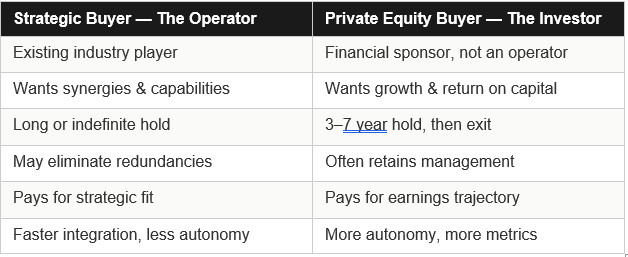
A strategic buyer is an operating company — often a competitor, a customer, a supplier, or someone in an adjacent market — that acquires your business because it fits into something it’s already doing. It wants your customers, your technology, your team, your distribution channel, or your geography. It’s buying capability or market position, not just a financial return.
A private equity buyer, by contrast, is a financial investor. It raises capital from institutions and wealthy individuals, deploys it into businesses, works to increase those businesses’ value, and then sells within a defined time frame — typically three to seven years. It is not an operator building a forever business; it is an investor managing a portfolio with return targets and fund lifecycles.
The valuation misconception
The most common assumption owners make is that strategic buyers always pay more. In some cases, this is true: a strategic acquirer can justify a higher purchase price because it’s capturing synergies — the cost savings or revenue gains that come from combining two businesses. For example, if merging your customer base with its eliminates $5M in overhead, it can bid that value into your price.
But the picture is more complicated. First, synergy estimates are notoriously optimistic and frequently don’t materialize on the schedule the acquirer projects. Second, strategic buyers often want to pay for those synergies themselves — not hand them over to you. Third, strategic buyers may discount the value of parts of your business that don’t fit their models, even if those parts are profitable.
“The highest headline number isn’t always the best deal.
A strategic’s price may come attached to earnouts, escrows, and integration terms that erode real proceeds significantly.”
Private equity buyers, meanwhile, are often more disciplined and consistent in their valuation methodology. They’re applying a multiple to your EBITDA, adjusted for quality of earnings, customer concentration, management depth, and growth trajectory. If your business is growing cleanly and the financials hold up in diligence, PE can be a very competitive buyer — especially in a strong M&A environment in which fund capital is plentiful.
What each buyer is really buying
A strategic acquirer is buying the outcome your business produces for it. If your proprietary software reduces its cost-to-serve by 18%, that’s what it’s paying for — not your revenue, not your team, not your brand. This means it’ll value certain assets highly and others not at all. Expect deep scrutiny of customer contracts, technology ownership, and competitive moat.
A PE firm is buying a financial asset with a predictable return profile. It wants stable, growing cash flows; a defensible market position; and a management team capable of executing a growth plan without the fund’s daily involvement. It’s sizing up how much debt the business can service, how many adjacent acquisitions could be bolted on, and what exit multiple a future buyer might pay in five years.
This means it’ll stress-test your EBITDA margins, your customer retention, and your dependence on any single person — including you, the founder. If the business doesn’t run without you in the room, it’ll either price that risk into its offer or ask you to stay and manage through it.
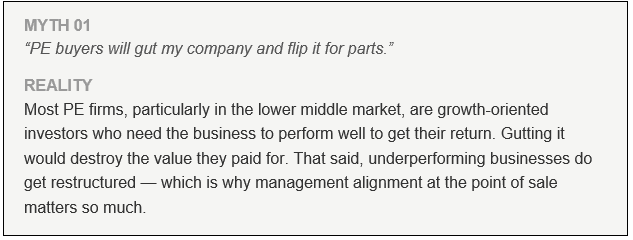
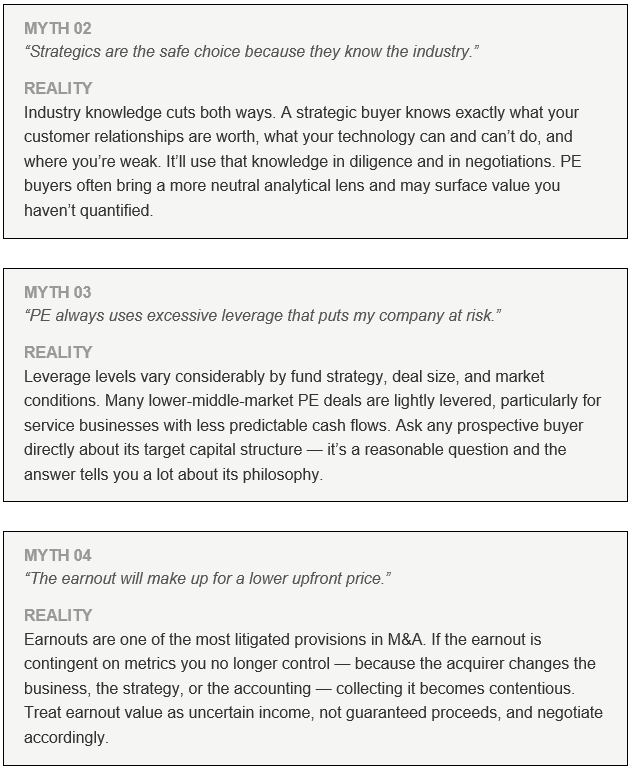
Common myths — and the reality behind them
The question of legacy and people
For many owners, particularly founders, the fate of employees and the continuation of company culture are as important as purchase price. This is an area in which strategic and PE buyers diverge sharply — and in which sellers often have more negotiating leverage than they think.
Strategic acquirers frequently consolidate operations post-close. If they already have a finance team, an HR department, and a regional sales force, they may not need yours. Positions get eliminated. How quickly and how broadly depends on the acquirer’s integration approach, but sellers should ask specific questions: What happens to the existing leadership team? Will this location remain open? How long before we’re fully integrated?
PE firms, particularly those backing a management-led buyout, tend to retain the existing team — at least initially — because that team is part of what they’re buying. Turnover post-close hurts performance, which hurts returns. They have a financial incentive to keep people in place. That said, if performance targets aren’t met, management changes do happen, and they can be abrupt.
“Neither buyer type is inherently ‘better’ for your people.
The answer depends largely on the seller’s circumstances, including motivation, goals, objectives, and overall involvement in the business.”
Speed, process, and deal certainty
Strategic buyers can move fast — or incredibly slowly. A corporate acquirer requires internal approvals, board sign-offs, and sometimes regulatory review. Strategic logic can become political inside a large organization. Deals that seemed certain have fallen apart after months of exclusivity because the acquiring company’s priorities shifted or a new CFO came in with a different view of M&A.
PE firms, by contrast, are in the business of doing deals. Their entire organizational structure is built around closing transactions efficiently. Experienced PE sponsors move through diligence in a defined process and are generally more predictable about timelines. They’re also more experienced at the mechanics of deal-making, which can reduce friction in negotiating the particulars of a transaction.
Deal certainty matters. A slightly lower offer from a buyer with a high probability of close is often preferable to a higher bid from a buyer who might walk away over a diligence finding or who requires three layers of internal approval. Your M&A advisor should be helping you score the full picture — not just the price.
How to think about the two paths
There is no universally correct answer about which buyer type is right for your business. The answer depends on your goals: Do you want maximum liquidity now or continued participation in future upside? Do you care about preserving the brand and team? Are you ready to exit entirely, or do you want to stay involved? Are you optimizing for tax efficiency, deal speed, or certainty of close?
Some sellers run a dual-track process, soliciting interest from both strategic and financial buyers simultaneously. This creates competition that benefits the seller and provides market clarity about relative valuations. Done correctly, it maximizes optionality. Done poorly — with inconsistent messaging or inadequate preparation — it can create confusion and erode confidence in the process.
The most important thing is to enter the process with clear eyes about what each buyer type is optimizing for. Strategics are buying synergies. PE firms are buying returns. Neither is doing you a favor. Both are disciplined capital allocators who will negotiate hard and walk away from a bad deal. The best outcome for sellers comes from understanding the buyer’s perspective well enough to speak its language, meet its concerns, and structure a transaction that works for both sides.
Your business represents years — possibly decades — of work. The buyer selection process deserves at least as much rigor as the business itself received.
© Copyright by Chris Duncan, Director, EdgePoint Capital, merger & acquisition advisors. All rights reserved. Chris can be reached at 216-342-5754
Related Insights
-
Selling Without Regret: What Owners Should Know
 By John Herubin, Managing Director Most owners spend decades building a company by investing both emotional and financial equity to achieve success. ...
 -
Diversification vs. Specialization: How Buyers Price Machine Shops
 By Gary Dagres, Director For owners of precision machining and metal fabrication businesses, one of the biggest questions in a sale process...
 -
Selling Your Facility Services Company to a Private Equity Platform: What Owners Should Know
 By Tom Stafford, Managing Director Across HVACR, Electrical, Plumbing, Roofing, Fire Protection, Landscaping, and other adjacent segments of the Facility Services market,...