
When Planning Maximizes Generosity
By John Herubin, Managing Director
In EdgePoint’s 25+ year existence, we have represented numerous business owners who upon the completion of the sale of their company, have been extremely generous with the proceeds received.
Examples include:
- Multi-generation family sale where the patriarch donated substantial proceeds to a Christian foundation that will benefit causes that he and his wife support.
- Fourth generation owner decided to donate post-sale proceeds to the medical school of a college to study a rare disease afflicting his daughter that didn’t receive much research attention.
- Second generation owner who wanted to reward long-time employees and gift each one a significant amount for each year they had been employed by the company. Many employees had been with the company for decades and it helped them pad retirement accounts, pay off mortgages, and put children and grandchildren through college. Many employees wept upon receiving the unexpected bounty.
In each instance the owner used their post-tax transaction proceeds to make the gifts (taxes paid were millions of dollars). We’re certain that owners with a charitable or gifting inclination would prefer to maximize both the amount and impact of their generosity, while minimizing taxes.
Putting the punchline first, the earlier in advance a business owner prepares to sell the company, the greater the flexibility and likelihood of avoiding taxes on sale proceeds that are going to be designated for gifting or charitable purposes.
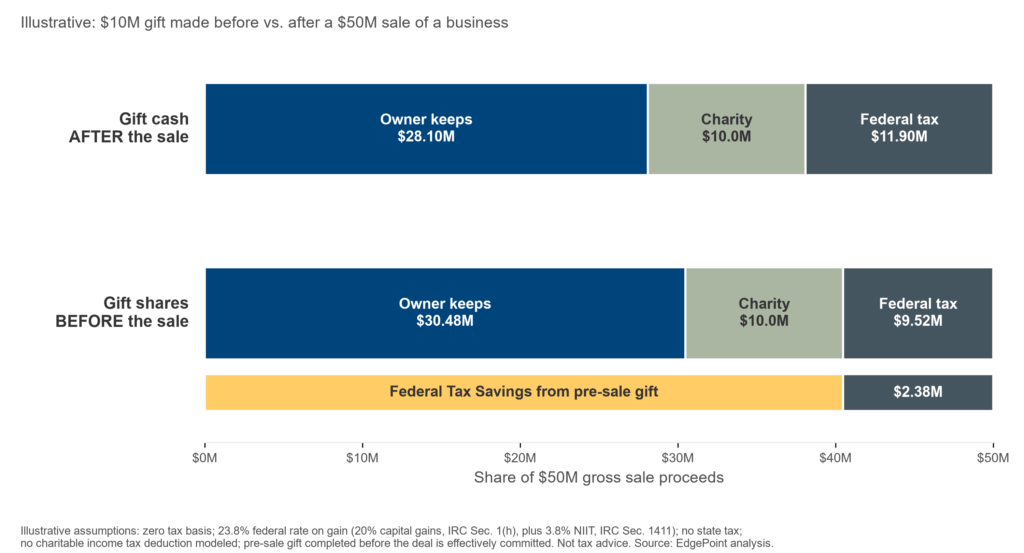
Illustrative Tax Savings Example:
Let’s review a few considerations/issues to consider:
For most founders, selling the company is the largest financial event of their lives, and it is also the point after which several of the best planning options are no longer available. Gifting is among them: transferring ownership to family members, trusts, or charitable organizations well ahead of a sale can move future growth out of the owner's estate, whereas a transfer made too close to a deal can attract IRS scrutiny and give a buyer's diligence team something to question or worse a post-sale audit that disrupts time when the owner should be enjoying their post-sale life.
Timing of gifts in advance of a sale and the structures used to achieve them require thought and should include professional guidance (legal, tax accounting, valuation providers, investment banking) as well as collaboration with family and charitable organizations. The rules, correct timing, and implementation can be intricate and essential for success.
External factors play a role as they pertain to legislation governing estate and gift tax planning. As witnessed by recent legislation (Big Beautiful Bill – 2025) and mid-term election results, the winds of change and resulting impact on estate and gift tax planning can occur rapidly.
What changed under the new law in 2025
Beginning in 2026, each person can transfer $15 million during life or at death before federal gift or estate tax applies, which is $30 million for a married couple, meaning a married couple can gift up to $30 million dollars before incurring any current Federal gift tax liability. Separate annual gift tax exclusion amounts apply to individuals too that are not counted against the $30 million above. Because the Act left state estate taxes untouched in states that impose their own tax, individual state rules should also be looked at separately.
Pre-Sale Strategies to consider
Gifts of minority interests - A minority stake in a private company can be valued with discounts for lack of control and lack of marketability, so a gift of a given size uses less of the donor's gift tax exemption, and because the IRS looks closely at these discounts, a qualified independent appraisal is essential. This enables donors to transfer shares at a much lower value than they would be valued in a third-party sale process thus achieving the gift intent without potentially triggering or possibly minimizing gift tax liability.
Trusts - Gifts to irrevocable trusts such as spousal lifetime access trusts, grantor retained annuity trusts (GRAT) and intentionally defective grantor trusts when made in advance of a sale can also remove future appreciation from the owner's estate while achieving a gift or charitable intent. When the shares are ultimately sold, trusts will receive the likely higher market value on a tax-free basis to support the beneficiaries.
Qualified Small Business Stock (QSBS) stacking - This is a unique provision under the Internal Revenue Code (IRC) that enables certain privately-held shareholders to sell their ownership federal income tax free (with certain limits). Under IRC Section 1202(h), someone who receives QSBS by gift takes on the donor's holding period and QSBS status, and because the exclusion cap applies per taxpayer, gifts to separate non-grantor trusts can multiply the exclusion available on a sale. This is a sophisticated planning strategy, so owners considering this should seek experienced legal advice. When executed correctly, the benefits are substantial.
Charitable gifts of stock - Contributing appreciated shares to a charity or donor-advised fund before a sale can avoid the gain on those shares, provided the gift is complete before the sale process reaches the point where the deal is effectively committed. There are a multitude of trust and estate planning vehicles to accomplish this goal (beyond the scope of this discussion), but again the benefits can be material for those with charitable intent. There are legal issues to consider when using this strategy at both the federal and state levels so experienced legal counsel in structuring is essential.
Gift Timing relative to receiving a Letter of Intent (LOI) - Risk will be dictated by timing. Most advisors recommend completing transfers before any binding agreement, and ideally before a LOI is received, because later gifts may invite an assignment-of-income challenge, in which the IRS treats the seller as having earned the proceeds before giving them away and forfeiting the tax benefits of any related gifts or donations. An LOI is not definitive that a sale is occurring since deals can fall apart over financing, diligence or competing bids, although the closer a sale gets to certain close, the greater the assignment-of-income risk becomes with the IRS.
Risk therefore builds with each step toward a signed deal, and a gift made years before a sale sits at a very different point on the risk scale than one made days before closing.
Significant gifts also require a gift tax return (IRS Form 709). Gifts above exclusion limits require adequate disclosure with a supporting valuation that starts the usual three-year review period, whereas without it the IRS can challenge the value indefinitely.
Deal risks with buyers - A buyer's diligence will turn up every transfer, and new shareholders mean additional signatories on a purchase agreement along with requests for the trust documents, valuations and filings behind each gift. An owner who gifts late or keeps thin records gives the buyer reasons to ask questions and adjust terms, and because gifts change who benefits from the proceeds, family members and trustees should understand the sale process and its implications before it starts too.
Successfully maximizing gifts to charities or individuals before the sale of a company requires coordination and awareness by the owner’s professional advisory team. As illustrated above, no pre-sale planning will result in greater tax liability for the seller, less proceeds to the intended charitable beneficiaries and missed opportunities to have a greater impact overall. The rules surrounding the myriad of gift strategies and their effects on Federal and state income, gift, and estate taxes are complex and are best addressed early by competent professionals.
We here at EdgePoint have taken a proactive approach to determine whether our clients contemplating a sale also desire to benefit charitable or gift beneficiaries as part of the process. Where that exists we are coordinating the involvement of appropriate professionals to explore available strategies and ensure our clients goals and objectives are met to maximize the benefits of their intended generosity.
© Copyright by John Herubin, Managing Director, EdgePoint Capital, merger & acquisition advisors. All rights reserved. John can be reached at 216-342-5865
Related Insights
-
After the Build: The Long Game of AI Infrastructure Operations
 By Matt Keefe, Managing Director During Goldman Sachs’s recent earnings call, CEO David Solomon said the US “is in the middle of an AI...
-
Selling Without Regret: What Owners Should Know
 By John Herubin, Managing Director Most owners spend decades building a company by investing both emotional and financial equity to achieve success. ...
-
Diversification vs. Specialization: How Buyers Price Machine Shops
 By Gary Dagres, Director For owners of precision machining and metal fabrication businesses, one of the biggest questions in a sale process...